
January 2023

A mosaic of 690 frames obtained with Webb's Near Infrared Camera (NIRCam) instrument which constitutes one of the first images of the CEERS survey and shows in the insets some examples of primordial galaxies

An article accepted for publication in “The Astrophysical Journal” reports the results of a study of the structure and morphology of galaxies that existed in the first three billion years of life of the universe. A team of researchers used observations conducted with the James Webb Space Telescope as part of the CEERS survey to obtain enough detail to understand what primordial galaxies were like. The conclusion is a confirmation of previous research regarding the remarkable variety of shapes and structures and turned out even superior thanks to Webb. In many of them, the structures are already quite evolved, as in closer and younger galaxies.

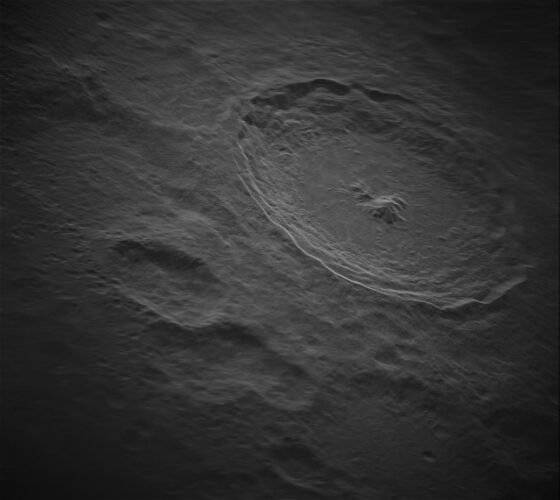
Radar image of Tycho Crater on the Moon (Image NRAO/AUI/NSF)

A new image of Tycho’s crater on the Moon is the most detailed yet captured from Earth. A collaboration between Green Bank Observatory (GBO), National Radio Astronomy Observatory (NRAO), Raytheon Intelligence & Space (RI&S), and Green Bank Telescope (GBT) produced the image thanks to a new radar technology that greatly improved astronomical applications of radars. Images of the lunar surface are just the beginning because other objects can be examined to create far more detailed images than radars could before. This result can be achieved with low-power radar transmitters.

The new scheme of the orbits of the planets of the TOI 700 system

An article accepted for publication in “The Astrophysical Journal Letters” reports the discovery of the exoplanet TOI 700 e. A team of researchers used observations conducted with NASA’s TESS space telescope and confirmed with other instruments to find it. It’s the fourth planet discovered in the TOI 700 red dwarf system and is interesting because it’s a rocky planet a bit smaller than Earth. Its habitability potential is yet to be assessed because it’s within the so-called optimistic habitable zone, where a planet can only have liquid water on its surface for part of its history.

The Dragon cargo spacecraft departing the International Space Station to end its CRS-26 mission (Image NASA)

A little while ago, SpaceX’s Dragon spacecraft ended its CRS-26 (Cargo Resupply Service 26) mission for NASA splashing down smoothly off the Florida Coast. The Dragon left the International Space Station last Monday. For SpaceX, this was the 6th mission of the 2nd contract with NASA to transport supplies to the Station with the new version of the Dragon cargo spacecraft.

Shortly after the splashdown, SpaceX’s recovery ship went to retrieve the Dragon to transport it to the coast. The cargo brought back to Earth will be delivered to NASA within a few hours. The Dragon spacecraft reached the International Space Station on November 27, 2021.

The six barred spiral galaxies identified by the James Webb Space Telescope

An article accepted for publication in “The Astrophysical Journal Letters” reports the discovery of six barred spiral galaxies that are between 8.4 and 11 billion years old. A team of researchers used the James Webb Space Telescope within the CEERS survey to observe enough details of these galaxies to identify the two extensions of stars that start from their center and reach the outer disk in a structure that resembles a bar. It’s a crucial structure for the evolution of these galaxies, as it favors the growth of the supermassive black holes at their center and star formation in their central regions.