
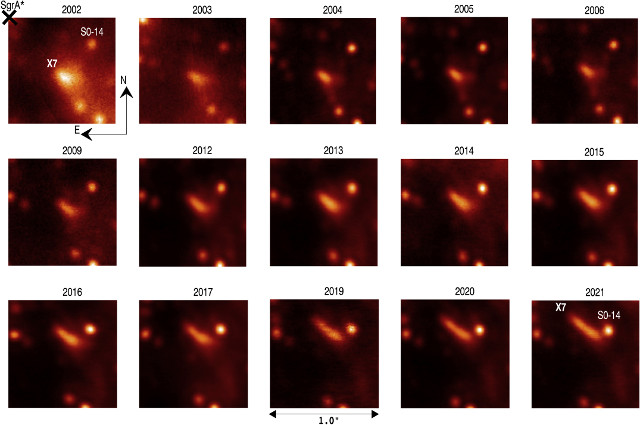
An article published in “The Astrophysical Journal” reports the results of twenty years of observations of a giant filament of gas and dust that is progressively approaching Sagittarius A*, the supermassive black hole at the center of the Milky Way. A team of researchers from the Keck Observatory and UCLA’s Galactic Center Orbits Initiative (GCOI) used Keck’s OSIRIS and NIRC2 instruments to keep an eye on this filament, cataloged as X7, to study its orbit and shape’s evolution. According to predictions, in 2036, X7 will get close to Sagittarius A* to the point of dissipating and be devoured. This will be a really interesting event to study even more deeply what happens in that really extreme environment.
Noticed for the first time in 2004, the X7 filament was also present in archival images collected since 2002 at the Keck Observatory obtained by the Galactic Center Orbits Initiative (GCOI), which studies Sagittarius A* and the environment around it. That’s a long-term program that has been collecting data at the Keck Observatory for more than 25 years to study gravity’s behavior near a supermassive black hole. The top image (Cortesia A. Ciurlo et al./UCLA GCOI/W. M. Keck Observatory) shows images captured by the NIRC2 instrument using adaptive optics showing the evolution of X7 between 2002 and 2021.
The GCOI uses observations conducted with the OH-Suppressing Infrared Imaging Spectrograph (OSIRIS) and Near-Infrared Camera, second generation (NIRC2) in combination with adaptive optics systems, which compensate for distortions caused by the Earth’s atmosphere, mounted on the Keck I and Keck II telescopes.
The X7 filament consists only of gas and dust and is not associated with other objects such as stars. For this reason, it’s inevitable that its progressive approach to Sagittarius A* will continue to stretch it until it’s dissipated and swallowed by the supermassive black hole.
Having twenty years of observations of the filament X7 is interesting for astronomers because it shows the evolution of its shape and especially its stretching. Its mass is estimated to be around 50 times the Earth’s and its orbit is completed in about 170 Earth years. Its length is now about 3,000 times the distance of the Earth from the Sun.
The researchers offer various hypotheses regarding the origin of the filament X7 but, at least for the moment, the available information can’t lead to conclusions. Determining the origin of X7 isn’t possible but the researchers calculated that its trajectory will take it to its closest approach to Sagittarius A* in 2036. At that point, it will be stretched so much as to dissipate it and the gas and dust that compose it will be eaten by the supermassive black hole. That process could generate more intense electromagnetic emissions due to the heating of the materials that compose it.
A filament of gas and dust not associated with stars or other solid objects may seem uninteresting. However, observing what happens to those materials as they orbit and slowly approach a supermassive black hole helps show what happens in a truly extreme environment. Growing gravitational effects can be measured to test relativistic and other models that are trying to explain as yet unclear phenomena. Two articles published in recent days, one in “The Astrophysical Journal” and one in “The Astrophysical Journal Letters”, indicate a link between supermassive black holes and the mysterious dark energy, so all studies connected to these objects can be useful in these cosmological investigations.

