
February 2023

The Progress MS-22 spacecraft blasting off atop a Soyuz-2.1a rocket (Image NASA TV)

A few hours ago, the Progress MS-22 spacecraft blasted off atop a Soyuz-2.1a rocket from the Baikonur Cosmodrome in Kazakhstan. After about nine minutes it successfully separated from the rocket’s last stage and was placed on its route. The cargo spacecraft began its resupply mission to the International Space Station also called Progress 83 or 83P. In this mission, the route used is the one that requires about two days.

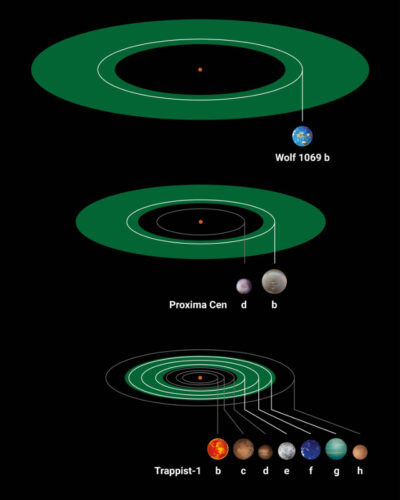
A comparison between the systems of Wolf 1069, Proxima Centauri, and TRAPPIST-1

An article published in the journal “Astronomy & Astrophysics” reports the identification of the exoplanet Wolf 1069 b, which has a mass close to the Earth’s and orbits within its star system’s habitable zone. A team of researchers led by Diana Kossakowski of the Max Planck Institute for Astronomy used the CARMENES spectrographs mounted on the 3.5-metre telescope of the Calar Alto Observatory, Spain, to identify traces of Wolf 1069 b using the radial velocity method. This exoplanet is tidally locked with its star, which poses a problem for habitability, but its star doesn’t have powerful flares. These characteristics make Wolf 1069 b an interesting object of study.

The galaxy LEDA 2046648 together with many stars and especially galaxies seen by the James Webb Space Telescope

An image captured by the James Webb Space Telescope portrays the galaxy LEDA 2046648 immersed in a vast group of other more or less distant galaxies. Many spiral galaxies are recognizable and this is to be expected as they’re the most common type. The NIRCam instrument captured many details of LEDA 2046648 despite being over a billion light-years away from Earth, but Webb’s performance is no longer astonishing. The observation that generated this image is among those used to calibrate the NIRISS instrument, which was out of service for a couple of weeks in the second half of January 2023 but has now resumed transmitting the collected data normally.

Artist's impression of a magnetar eruption. (Image NASA's Goddard Space Flight Center)

An article published in the journal “Nature Astronomy” reports an explanation for the abrupt slowdown in the rotation of the magnetar cataloged as SGR 1935+2154 and its attribution to a sort of volcano that ejected a kind of wind into space. A team of researchers used X-ray data from ESA’s XMM-Newton space telescope and NASA’s NICER instrument to analyze changes in the magnetar. Their conclusion is that the activity of the pseudo-volcano altered the magnetar’s magnetic field, slowing down its rotation, what in jargon is called anti-glitch. That led to the beginning of radio wave emissions subsequently detected by the Chinese FAST radio telescope.