March 2023

The star X3a in its envelope of gas and dust (Image courtesy Florian Peißker)

An article published in “The Astrophysical Journal” reports the discovery of a very young and massive star, cataloged as X3a, in an environment in which it shouldn’t exist, as it orbits Sagittarius A*, or simply Sgr A*, the supermassive black hole at the center of the Milky Way. A team of researchers led by Florian Peißker of the Institute of Astrophysics at the University of Cologne, Germany, used several instruments to locate X3a.

According to the researchers, the star must have formed in a cloud farther from Sagittarius A* and then been attracted by it. This suggests a model of star formation near an environment where conditions seem impossible.

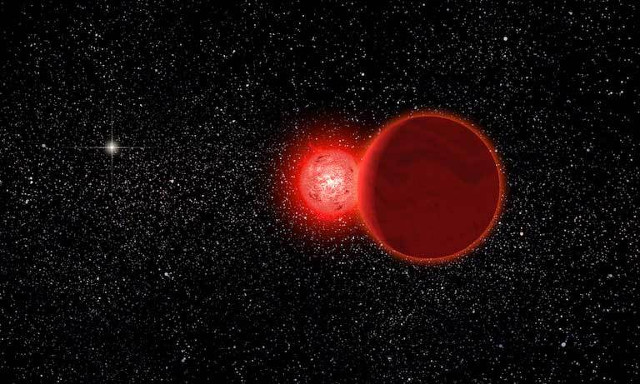
Artist's concept of Scholz's star with its companion, a binary system that might be similar to LP 413-53AB (Image Michael Osadciw/University of Rochester)

An article published in “The Astrophysical Journal Letters” reports the discovery that the system cataloged as LP 413-53AB consists of two ultracool dwarf stars that orbit each other in just 17 hours. A team of researchers led by Chih-Chun “Dino” Hsu of Northwestern University used observations conducted with the Keck Observatory telescopes to resolve two stars so small and so close. Previously, three binary systems composed of ultracool dwarfs had been discovered but they were young stars in astronomical terms while the pair of LP 413-53AB is estimated to be some billion years old. We don’t know how difficult these pairs are to find due to their weak emissions, and explaining the existence of LP 413-53AB is difficult.

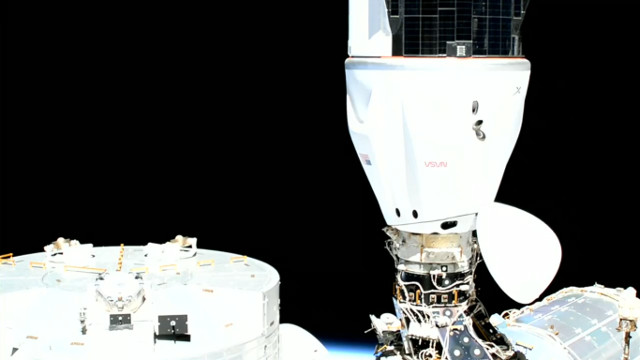
SpaceX's Crew Dragon Endeavour spacecraft docked with the International Space Station (Image NASA TV)

A few hours ago, SpaceX’s Crew Dragon Endeavour spacecraft docked with the Harmony module of the International Space Station completing the first part of its Crew-6 or SpaceX Crew-6 mission that began with its launch a little more than 24 hours earlier. After checking that the pressure was properly balanced, the hatch was opened to allow Andrey Fedyaev, Stephen Bowen, Warren Hoburg, and Sultan Alneyadi to enter the Station and start their mission, which will last about six months.

SpaceX's Crew Dragon Endeavour spacecraft blastin off atop a Falcon 9 rocket (Photo NASA/Frank Michaux)

A few hours ago, SpaceX’s Crew Dragon Endeavour spacecraft blasted off atop a Falcon 9 rocket from the Kennedy Space Center in its Crew-6 or SpaceX Crew-6 mission. After almost exactly twelve minutes, it successfully separated from the rocket’s last stage and went en route to carry out its mission. This is the 6th crewed mission of the Crew Dragon spacecraft within the normal rotation of the International Space Station crew. This is also the fourth mission for the Endeavour.

Tycho supernova remnants (X-ray (IXPE: NASA/ASI/MSFC/INAF/R. Ferrazzoli, et al.), (Chandra: NASA/CXC/RIKEN & GSFC/T. Sato et al.) Optical: DSS Image processing: NASA/CXC/SAO/K. Arcand, L.Frattare & N.Wolk)

An article to be published in “The Astrophysical Journal” reports a study on Tycho supernova remnants which offers new information on the geometry of its magnetic fields. A team of astronomers led by Riccardo Ferrazzoli of the Italian National Institute of Astrophysics used observations conducted with the IXPE space telescope to examine the polarized X-rays emitted by these supernova remnants. This allowed new clues to be found about the conditions in the shock waves generated by the supernova that accelerate particles to speeds close to the speed of light.