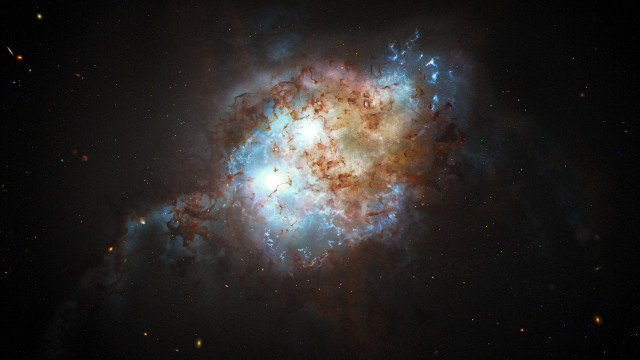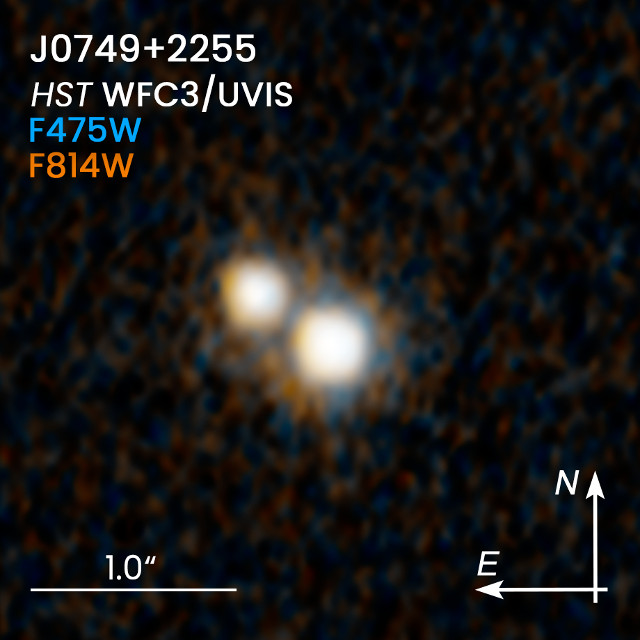
An article (link to the file in PDF format) published in the journal “Nature” reports the discovery of a pair of merging galaxies cataloged as SDSS J0749+2255 which has the peculiarity of hosting a double quasar. A team of researchers led by the University of Illinois at Urbana-Champaign used various ground-based and space telescopes to study SDSS J0749+2255 to obtain observations detailed enough to resolve the two quasars, both of which are extremely bright. The difficulty in these observations is also given by the fact that this pair is very distant and we see it as it was when the universe was about three billion years old and the distance between the two supermassive black holes that power their respective quasars is only about ten thousand light-years.
Quasars are the brightest objects in the universe because they’re powered by supermassive black holes that heat materials around them to such an extent that they generate very strong electromagnetic emissions. This extreme case of an active galactic nucleus is generally visible billions of light-years away, in the early universe, in galaxies in which the amount of gas and dust orbiting supermassive black holes is very high.
In the early universe, another very common process was the merger of galaxies. Occasionally, this merger could involve two galaxies hosting as many quasars, with the end result of generating an even more colossal supermassive black hole. The problem is being able to find pairs of primordial galaxies merging with two quasars, a difficult task but possible with the best instruments made available to astronomers in recent decades.
The discoverers of the two quasars of the pair SDSS J0749+2255 searched for possible candidates in the archives of ESA’s Gaia space probe, which has been mapping billions of objects in the sky for years. Certain brightness changes in a quasar can show fluctuations caused by variations in their activity. In a pair of quasars, those variations would be different on either side of an apparent single quasar.
The verification of the nature of SDSS J0749+2255 was done using observations conducted in various electromagnetic bands with space telescopes such as Hubble and Chandra and ground-based telescopes such as Keck and Gemini North, both in Hawaii. The coverage of the electromagnetic spectrum reached down to radio waves with the use of the Very Large Array radio telescope network.
It was important to obtain independent confirmation that there were indeed two quasars because the pair could only be apparent. It could be a nearby star aligned to a single quasar or an image of a single quasar doubled by a gravitational lens.
We see the pair SDSS J0749+2255 as it was over ten billion years ago. Now the result is probably a giant elliptical galaxy similar to M87, whose supermassive black hole became famous in 2019 because the image of the area around it was the first to be published by the Event Horizon Telescope project.
According to Xin Liu, professor of astronomy at the University of Illinois at Urbana-Champaign and one of the authors of this study, we’re beginning to reveal the tip of the iceberg of the population of primordial binary quasars. This team showed a method to identify them even if they’re separated by less than half the size of a single galaxy. In the case of SDSS J0749+2255, the distance between the two quasars was estimated at around ten thousand light-years, very little on that cosmic scale.
Discovering other pairs of quasars in merging galaxies will help reconstruct the history of the evolution of galaxies in the early universe. When NASA’s Nancy Grace Roman Space Telescope mission begins, this task will become easier thanks to its capabilities, superior to Hubble’s in various ways.