
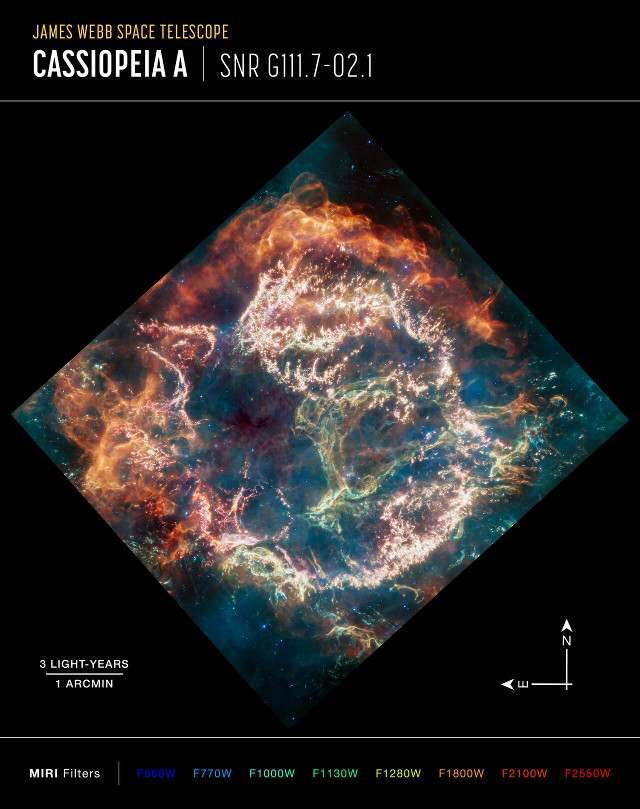
An image of the supernova remnant cataloged as Cassiopeia A (NASA, ESA, CSA, D. Milisavljevic (Purdue University), T. Temim (Princeton University), I. De Looze (UGent), J. DePasquale (STScI)), or simply Cas A, captured by the James Webb Space Telescope shows never-before-seen details of the structures present within the materials surrounding what remains of the progenitor star. These are useful details for astronomers to reconstruct the processes that take place in the last stages of the life of a massive star and the consequences of a supernova. Elements generated by the star are scattered into space, including cosmic dust in quantities that could explain the abundance discovered in early galaxies.
About 11,000 light-years away from Earth, the supernova remnant Cassiopeia A has been studied many times with various instruments but there are no traces of supernova observations in historical records. Reconstructions indicate that its light should have reached Earth about 340 years ago but for some reason, it wasn’t seen. Interstellar dust might have blocked most of that light, or the parent star’s outer layers blocked the light after they were ejected shortly before the supernova.
Even the study of this supernova remnant is far from simple because the massive presence of materials is the object of interest of astronomers but that’s also what blocks many electromagnetic frequencies. Infrareds are among the emissions detectable from Earth, which is why instruments such as the Hubble Space Telescope have been used in the past to study Cassiopeia A. The James Webb Space Telescope offers a breakthrough in this study.
The Mid-InfraRed Instrument (MIRI) is the one used in particular for the observations of the Cassiopeia A supernova remnant. Various filters made it possible to obtain the new image which covers a radius of about 10 light-years, revealing many new details on the structures formed by materials ejected in various phases that started when the progenitor star was dying. It’s a new case where the result is a breathtaking image that is also very useful to astronomers.
The amount of cosmic dust produced by the Cassiopeia A supernova remnant is one of the objects of study. Observations of early galaxies revealed large amounts of cosmic dust that is difficult to explain without involving supernovae. Attempts to accurately estimate the amount of dust generated by supernovae haven’t led to final conclusions and now the hope is that new studies conducted with the James Webb Space Telescope will help astronomers in this type of research as well.
Studying the materials of supernova remnants aims to understand how they spread through space and what chemical elements they include. That’s important because those materials could, in the distant future, become part of planets in new star systems. Some of the elements generated by the progenitor star are essential for the Earth’s life forms and perhaps also for other life forms that emerged around the universe.
