
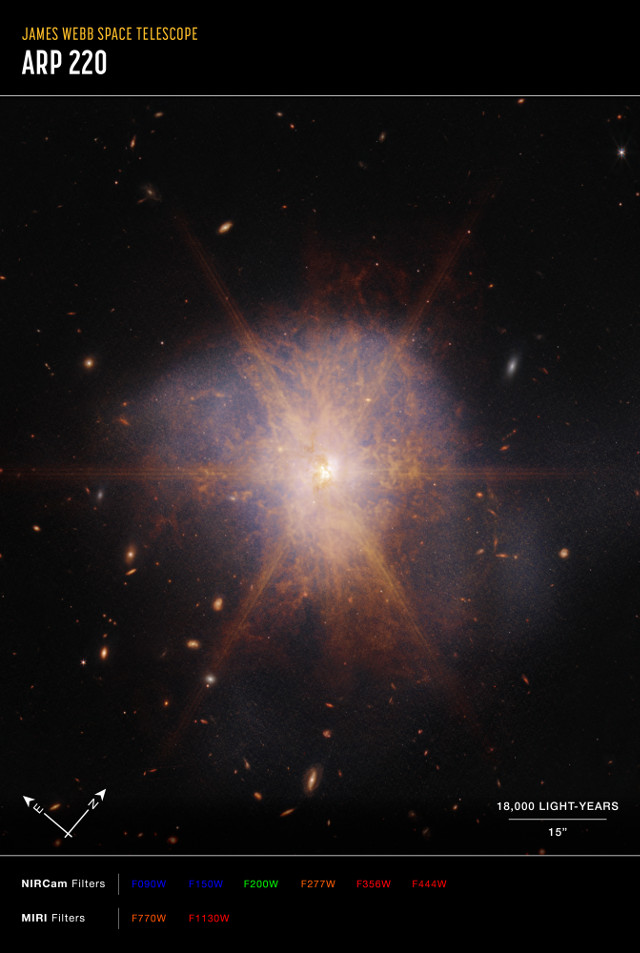
An image (NASA, ESA, CSA, STScI. Image processing: Alyssa Pagan (STScI)) captured by the James Webb Space Telescope portrays Arp 220, a galaxy that is the result, still not fully completed, of a galaxy merger. Intense processes are ongoing within this new galaxy as a consequence, starting with a remarkable star formation activity. X-ray emissions detected by other instruments suggest the presence of an active galactic nucleus. These are activities connected to its nature as an ultraluminous infrared galaxy (ULIRG) whose emissions allowed Webb to capture many new details.
Many examples of galaxy mergers in various stages are known and among them, Arp 220 is a case where that process is almost completed. Astronomers studied this galaxy about 250 million light years from Earth with many instruments to try to understand the final consequences of a galaxy merger between two spiral galaxies whose beginning was estimated at about 700 million years ago.
Arp 220’s extreme infrared brightness, estimated at over a trillion suns, made it an ideal object of study with instruments that are sensitive in that electromagnetic band such as the Hubble Space Telescope in recent decades and now with the James Webb Space Telescope as well.
The merger between two galaxies can generate shock waves due to the gravitational effects exerted on the clouds of gas and dust inside them. The consequence is the triggering of new star formation processes. In Arp 220, this type of process was intense making the new galaxy of the type called starburst exactly due to the remarkable star formation.
About 200 large star clusters were spotted in a region about 5,000 light-years across. They were formed thanks to an enormous amount of gas, estimated at an order of magnitude similar to that of the entire Milky Way concentrated in a volume that is very small from an astronomical point of view.
Arp 220 is the most common designation for this galaxy and derives from its inclusion in the atlas of peculiar galaxies by astronomer Halton Arp. That inclusion is due to the fact that its shape hasn’t reached a new equilibrium yet, so is still irregular. The two cores of the original galaxies are still separated and we see them about 1,200 light-years apart. Each of them has a star-forming ring that the James Webb Space Telescope detects thanks to their strong infrared emissions.
James Webb Space Telescope’s The Near-Infrared Camera (NIRCam) and Mid-Infrared Instrument (MIRI) instruments captured many new details that are useful to astronomers to better understand the processes in the final phase of the galaxy merger in progress in Arp 220. The intense star formation has been under study for years thanks to previous observations and the new images of the central area of the new galaxy will help to understand if it actually contains an active galactic nucleus and if that’s the case if the merger contributed to the activity of one of the supermassive black holes of the progenitor galaxies.
