
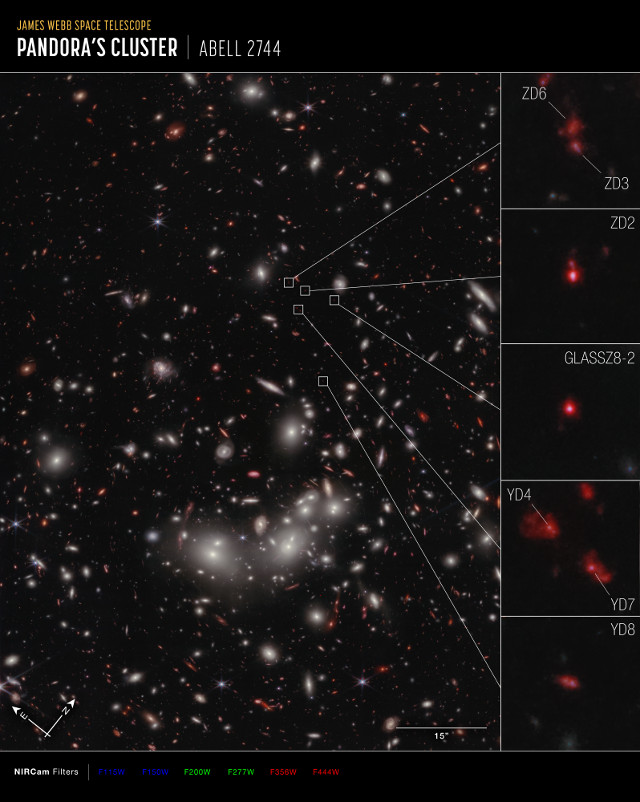
An article published in “The Astrophysical Journal Letters” reports the evidence for the discovery of the oldest galaxy protocluster known so far. A team of researchers led by Takahiro Morishita of Caltech identified the cluster in its formation phase which was cataloged as A2744-z7p9OD with the Hubble Space Telescope and then confirmed with the James Webb Space Telescope the presence of at least seven galaxies. They were forming a larger structure about 650 million years after the Big Bang and according to calculations, the cluster has grown over time to include many other galaxies.
Galaxy clusters are the largest structures in the universe and can even include thousands of galaxies. In the most extreme cases, we speak of superclusters, formed by a number of gravitationally linked clusters. The processes of formation and evolution of these structures are being studied and to understand them it’s important to be able to observe protoclusters.
The Frontier Fields program used the Hubble Space Telescope together with the Spitzer and Chandra Space Telescopes to exploit the gravitational lensing effect generated by the Abell 2744 galaxy cluster, located about 3.5 billion light-years from Earth. Abell 2744 distorts the light of the galaxies behind it, magnifying them and allowing to detect objects that otherwise wouldn’t be visible even using the most powerful instruments.
The image (NASA, ESA, CSA, Takahiro Morishita (IPAC). Image processing: Alyssa Pagan (STScI)) shows the galaxy cluster Abell 2744 and its surrounding area, including the views distorted by gravitational lensing of galaxies behind it. Among them are the seven galaxies identified in the A2744-z7p9OD protocluster, also seen in the insets.
Observations within the Frontier Fields program made it possible to identify some galaxies behind Abell 2744 but at the limit of the possibilities of the Hubble Space Telescope. An instrument that could detect frequencies beyond the near-infrared was needed, and now the James Webb Space Telescope offers that possibility. New observations made it possible to obtain details of the primordial galaxies and spectrographic measurements obtained using the Near-Infrared Spectrograph (NIRSpec) instrument allowed their distances to be accurately estimated. This confirmed that we see this galaxy protocluster as it was about 650 million years after the Big Bang.
NIRSpec also made it possible to estimate how fast the galaxies move within what appears to be a halo of dark matter. This is a very high speed since it’s about 1,000 kilometers per second. This result offers useful new information to test dark matter models and also alternative models that explain the gravitational effects attributed to this type of matter in ways that don’t include its existence.
The researchers plan to continue studying primordial galaxies in the same region as the ones attributed to the A2744-z7p9OD protocluster. They include various candidates that could be part of the protocluster but precise data needs to be obtained from the James Webb Space Telescope to verify it. Other galaxies in that region were likely attracted to and ended up becoming part of the cluster that formed over time. It’s all part of the work of reconstructing the history of the early universe to understand how the universe evolved into what we see today.
