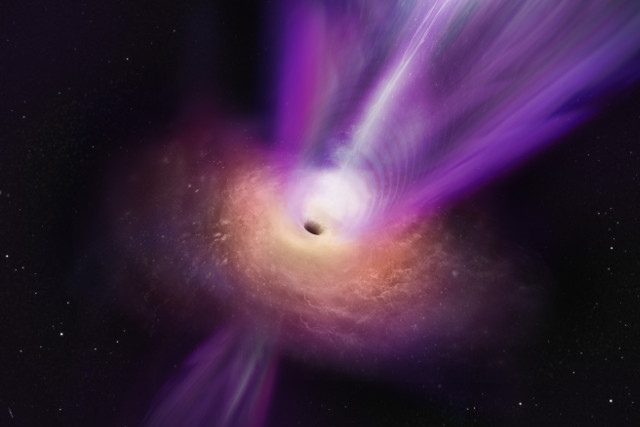
An article published in the journal “Nature” reports the results of the first observations ever obtained of the ring structure showing matter falling into the supermassive black hole at the center of the galaxy M87. A team of researchers used the ALMA and GLT radio telescopes and some of the ones part of the GMVA array to obtain the images they were looking for. These images show not only the area around the black hole but also the flows of materials that originate a relativistic jet. The collected data is useful to understand the mechanisms that lead those jets to reach the energies necessary to be accelerated to speeds approaching the speed of light.
Many cases have been observed in which supermassive black holes gobble up materials and emit jets of particles at their poles at such high energies that they are accelerated to extremely high speeds. Observing areas close to supermassive black holes is not easy, also because they are several million light-years away.
The supermassive black hole at the center of the galaxy M87 is relatively close and in a good position to observe it clearly. These are the reasons why it was chosen as the first target of observations by the EHT (Event Horizon Telescope) Collaboration for the now-famous image published in 2019. However, to study the relativistic jet visible from Earth, somewhat different observations were needed.
For this specific study, the researchers conducted detections at a wavelength of 3.5 millimeters, which are more suitable for revealing the larger structures of the source than the 1.3 millimeter wavelength used by the EHT Collaboration. In this new study, they used a combination of the Atacama Large Millimeter/submillimeter Array (ALMA), Greenland Telescope (GLT), and some of the Global Millimeter VLBI Array (GMVA) radio telescopes.
The combination of observations conducted at 3.5 mm with ALMA, GLT, and GMVA showed a ring structure that has a diameter that is 50% larger than what was observed with the EHT at 1.3 mm. This matches the predictions regarding the emission of plasma at relativistic speeds in that area.
The emissions from that region of the galaxy M87 are produced by the interaction between highly energetic electrons and magnetic fields in what is called synchrotron radiation. The observations show new details of these electrons’ location and energy. They also tell us something about the black hole itself, specifically, that it’s not very hungry since it consumes the matter of the ring at a low speed converting only a small fraction into the radiation that supplies the jet with the energy to reach relativistic speeds.
Studies of the area around the supermassive black hole at the center of M87 will continue. A new campaign of observations is already underway and radio telescopes such as the Sardinia Radio Telescope are being improved and in the future, they will be able to contribute to 3.5 mm surveys to capture more details of the ongoing processes. For example, the data suggests that in addition to the gas falling into the supermassive black hole, there’s some kind of wind causing turbulence and chaos around it. The new investigations will be able to show even more what’s happening around these truly extreme objects.