
An article published in the journal “Nature Astronomy” reports the discovery of a second circumbinary planet that orbits the two stars that form the BEBOP-1 system. A team of researchers used the HARPS and ESPRESSO spectrographs to find for the first time a circumbinary planet using the radial velocity method. This exoplanet, cataloged as BEBOP-1 c, joins TOI-1338 b, discovered in 2020 thanks to NASA’s TESS space telescope. Estimates indicate that BEBOP-1 c is a gas giant with a mass around 65 times the Earth’s and a year lasting about 215 Earth days.
About 1,300 light-years from Earth, the BEBOP-1 system consists of a star slightly more massive than the Sun and a red dwarf whose mass is about one-third of the Sun’s. This system is also known as TOI-1338 because it was observed using the TESS (TOI = TESS Object of Interest) space telescope.
In 2020, TESS observations made it possible to identify the first planet of this binary system, cataloged as TOI-1338 b. It’s a gas giant with a mass that is almost 22 times the Earth’s for a radius that is almost 7 times the Earth’s and a year that lasts just over 95 Earth days.
The Tatooines, as the circumbinary planets are nicknamed in homage to Luke Skywalker’s planet from the Star Wars saga, are very interesting for astronomers to understand under which conditions their orbits remain stable and how they change over time under the influence of two stars. The European BEBOP (Binaries Escorted By Orbiting Planets) project has the precise aim of studying these exoplanets by improving their detection and conducting a survey to collect information on the population of Tatooines.
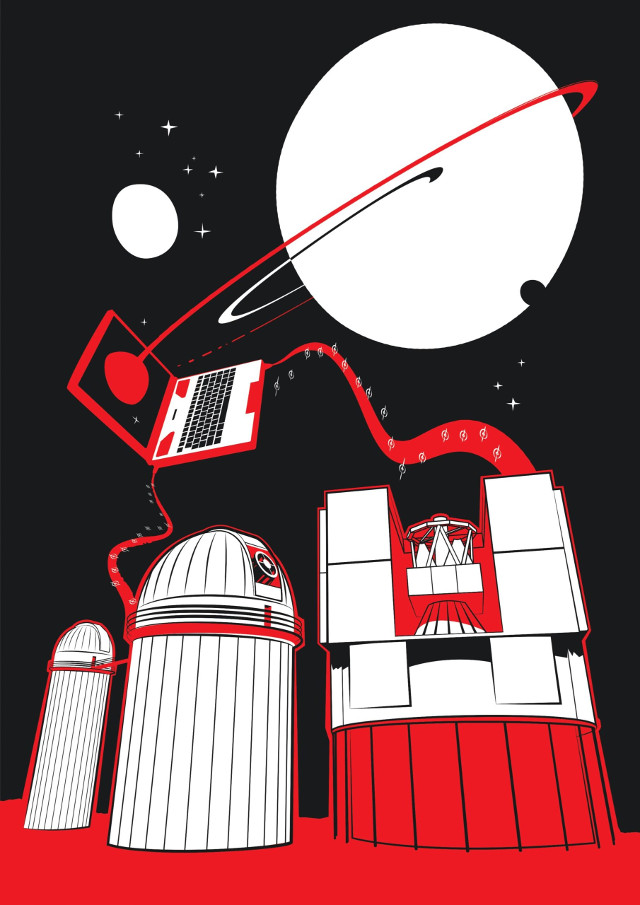
The authors of the study of TOI-1338/BEBOP-1 were trying to examine the exoplanet TOI-1338 b using the radial velocity method. They used two ESO spectrographs in Chile: HARPS (High Accuracy Radial velocity Planet Searcher), mounted on the 3.6-metre telescope at the La Silla Observatory, and ESPRESSO (Echelle SPectrograph for Rocky Exoplanet and Stable Spectroscopic Observations) mounted on the Very Large Telescope (VLT). However, the traces they found turned out to be from another exoplanet, the one cataloged as BEBOP-1 c. The image reproduces the TOI-1338/BEBOP-1 system, the two telescopes, and instruments used to find the new exoplanet celebrating the event.
Since the presence of the exoplanet BEBOP-1 c was detected without seeing it, we don’t know its size. The spectrographic traces allowed to provide a still approximate estimate of its mass, with a peak probability of 65.2 times the mass of the Earth but with a margin of error of almost 12 Earth masses. Its year estimate is more accurate, peaking at just over 215 Earth days and with a margin of error of just over 3 Earth days.
For now, only 12 binary systems with circumbinary planets are known, and only the Kepler-47 system has two identified circumbinary planets. Each new Tatooine discovered is important because it adds valuable information about these systems. Astronomers are still trying to understand under what conditions circumbinary planets can form and how they move due to the influence of the two stars.
To have precise measurements of the characteristics of the exoplanet BEBOP-1 c it will be necessary to wait for its transit to be observed. The configuration of the system suggests that this could happen in the future and more information could be obtained with observations to be conducted with the James Webb Space Telescope.
