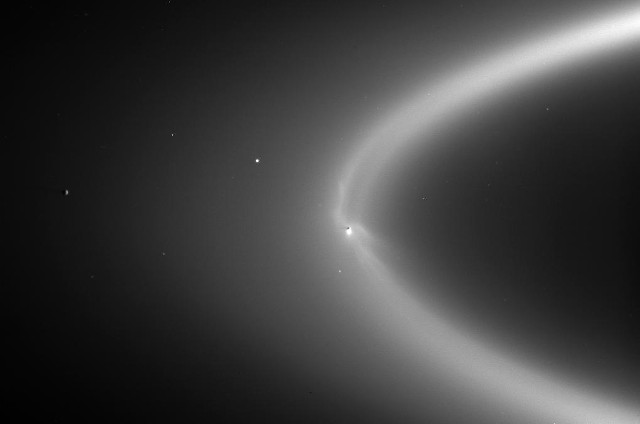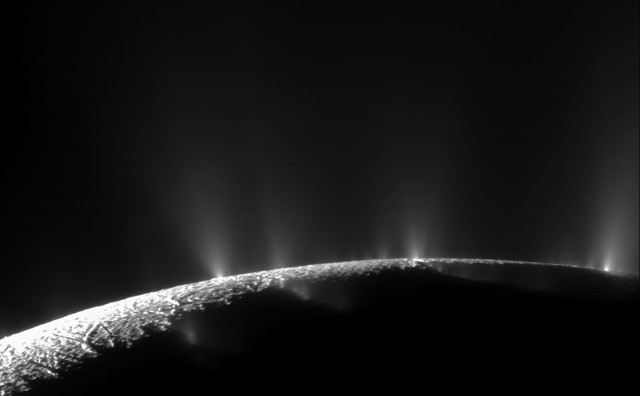
An article published in the journal “Nature” reports the discovery of phosphorus, a key element for many biological processes, on Enceladus, the moon of the planet Saturn which has an underground ocean of liquid water. A team of researchers led by Frank Postberg of the Freie Universität Berlin, Germany, analyzed data collected by the Cassini space probe made available in the Planetary Data System and in particular the data detected by the Cosmic Dust Analyzer instrument in samples of icy particles emitted by the geysers of Enceladus that arrived in one of Saturn’s rings.
The result of the analysis was the discovery of phosphates in concentrations at least one hundred times higher than those of the Earth’s oceans. Geochemical models suggest that phosphorus may be present in subsurface oceans of other moons. These discoveries increase the probability that life forms have arisen in the subsurface of some of those moons.
The mission of the Cassini space probe ended on September 15, 2017, but a wealth of data collected over the years has remained available to scientists and it will take years to complete its analysis. The discovery of Enceladus’ subterranean ocean and geysers in which organic compounds were found is one of the major achievements of this mission. This is the reason why many astrobiologists are focusing on the data collected by Cassini in its Enceladus flybys and its passages through the so-called E ring, the ring of Saturn formed by icy grains emitted by the geysers of Enceladus.
The Cassini space probe collected samples of the compounds emitted in Enceladus’ geysers, in which various building blocks of life were found. However, a key element for various biological processes such as phosphorus was never discovered. The team of planetary scientist Frank Postberg tried to examine the data collected by Cassini during its passages through the E ring, where the compounds emitted by Enceladus have accumulated. The result is the discovery of phosphorus salts in the icy particles.
The researchers tried to understand the consequences of their discovery through laboratory experiments and the use of geochemical models. Experiments indicate that there are several phosphates in Enceladus’ subterranean ocean in concentrations at least a hundred times higher than those present in the Earth’s oceans. Geochemical models suggest that phosphates may be abundant in other subsurface oceans in the solar system.
We know of the subterranean ocean of Europa, one of Jupiter’s big moons, and other moons of the largest of the solar system’s planets may also have one. Astronomers are looking at icy moons to figure out which ones have cores hot enough for water to be liquid underground. According to Frank Postberg and his collaborators, the chances of the presence of phosphates are greatest in moons that formed from primordial ice that contains carbon dioxide and where liquid water has easy access to rocks with which there can be interactions resulting in chemical reactions which produce phosphates.
The detection of phosphorus compounds increases the probability that life forms exist in the subterranean ocean of Enceladus but these are still hypotheses. Now we know for sure that the elements necessary for life forms similar to the ones on Earth are present and that in this moon’s subsoil there are hydrothermal sources similar to terrestrial ones where perhaps life was born. However, with regard to both Enceladus and Europa and even more other moons that have or could have subterranean oceans, it’s not yet possible to carry out direct investigations. Research is difficult but understanding if these moons can actually host life forms is important.