July 2023

The Herbig-Haro 46/47 object

An image captured by the James Webb Space Telescope portrays Herbig-Haro 46/47, or simply HH 46/47, a nebula of ionized gas that emits a faint light in which two lobes are very bright instead. The two numbers are due to the fact that there are two young stars still growing in the middle of a disk of gas and dust. Webb’s NIRCam (Near-Infrared Camera) instrument captured details of that area never seen before. The nebula is invisible at optical frequencies and is blue at infrared. The most spectacular part is the one characteristic of the Herbig-Haro objects with the ionized stellar winds forming two lobes visible in the image in orange hues.

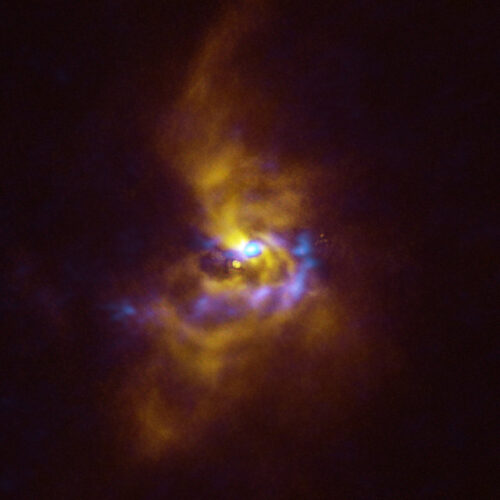
The V960 Mon system seen from SPHERE (yellow tones) and ALMA (blue tones) (Image ESO/ALMA (ESO/NAOJ/NRAO)/Weber et al.)

An article published in “The Astrophysical Journal Letters” reports the discovery of clumps of matter that could become planets around the young star V960 Mon. A team of researchers used the SPHERE instrument mounted on ESO’s VLT and the ALMA radio telescope, both in Chile, to examine the state of what could be a system in formation. The detection of masses estimated to be several times the Earth’s could constitute the first evidence of the formation of planets through the process of gravitational instability.

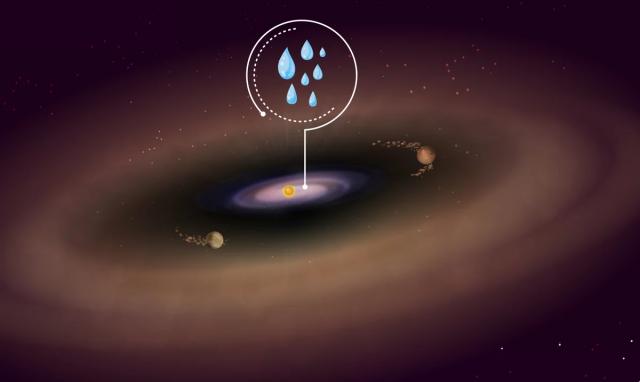
Artist's concept of the PDS 70 system: the star is surrounded by a protoplanetary disk in which two gas giant planets are forming. In the inner area, the zone where water was detected is indicated.

An article published in the journal “Nature” reports the discovery of water in the very young PDS 70 system. A team of researchers from the MINDS collaboration led by Giulia Perotti of the Max Planck Institute for Astronomy (MPIA) in Heidelberg, Germany, used the James Webb Space Telescope to detect the presence of water in the inner region of the protoplanetary disk surrounding the star PDS 70. Two planets were already identified in that disk and the detection of a debris cloud in a possible Trojan configuration was recently announced but there may also be rocky planets in formation on which water could play an important role in terms of habitability potential.

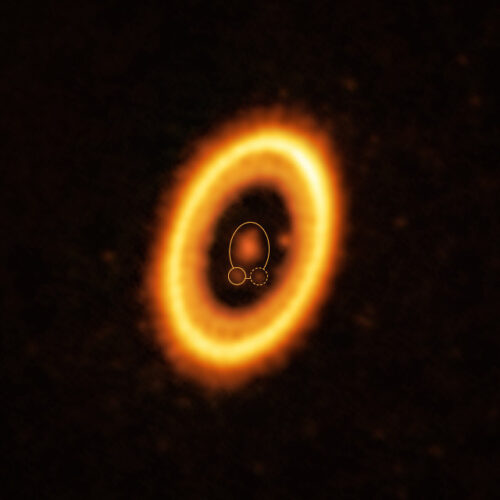
The PDS 70 system with its large protoplanetary disk. The larger circle indicates the orbit of the exoplanet PDS 70b, highlighted by another solid circle. A circle with a dashed line indicates the debris cloud that appears to occupy the same orbit.

An article published in the journal “Astronomy & Astrophysics” reports the discovery of a debris cloud that appears to share the orbit with the exoplanet PDS 70b. A team of astronomers reanalyzed observations conducted with the ALMA radio telescope to study the system of the very young star PDS 70 and its planets in their formation phase. The debris detected in the vicinity of PDS 70b could constitute another planet still in formation or be the remnants of a planet that had already formed.

JADES-GS-z13-0, JADES-GS-z12-0, and JADES-GS-z11-0

An article published in the journal “Proceedings of the National Academy of Sciences” reports the discovery of candidate supermassive dark stars observed by the James Webb Space Telescope. Cosmin Ilie, Jillian Paulin, and Katherine Freese argue that three of what were considered primordial galaxies have characteristics of a type of object that so far was only hypothesized. According to the model proposed in 2007, supermassive dark stars have a large dark matter component that powers them instead of nuclear fusion. These strange objects could reach masses up to ten million times the Sun’s and a brightness up to ten billion times the Sun’s, which could lead to mistaking them for primordial galaxies.