
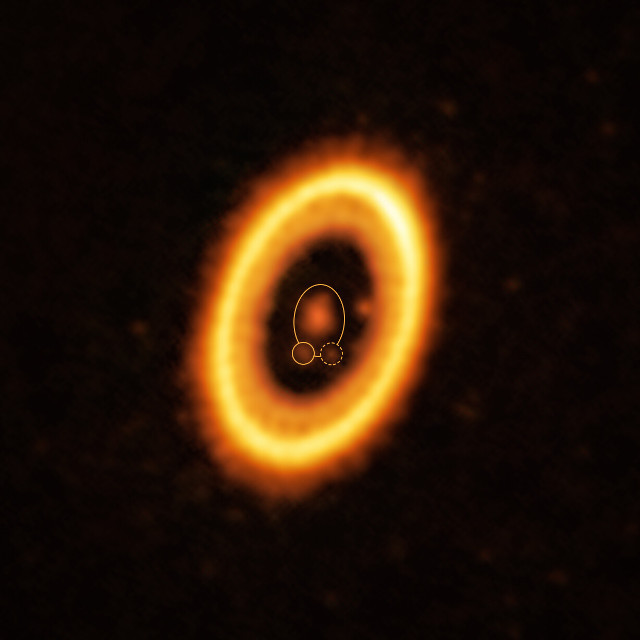
An article published in the journal “Astronomy & Astrophysics” reports the discovery of a debris cloud that appears to share the orbit with the exoplanet PDS 70b. A team of astronomers reanalyzed observations conducted with the ALMA radio telescope to study the system of the very young star PDS 70 and its planets in their formation phase. The debris detected in the vicinity of PDS 70b could constitute another planet still in formation or be the remnants of a planet that had already formed.
The image (ALMA (ESO/NAOJ/NRAO) /Balsalobre-Ruza et al.) shows the PDS 70 system with its large protoplanetary disk. The larger circle indicates the orbit of the exoplanet PDS 70b, highlighted by another solid circle. A circle with a dashed line indicates the debris cloud that appears to occupy the same orbit.
It would be the first time that objects sharing the same orbit have been found outside the solar system. Several asteroids share their orbit with the planet Jupiter and are known as Trojans, consequently PDS 70b and the possible “twin” would be Trojan exoplanets or exotrojan.
The PDS 70 system is considered particularly interesting because it’s still forming with a protoplanetary disk still surrounding the star and at least two growing planets. A study also showed the presence of a circumplanetary disk around the exoplanet PDS 70c which could indicate that one or more moons are forming. Various instruments have been used on several occasions to study the ongoing processes, including the Atacama Large Millimeter/submillimeter Array (ALMA) radio telescope, which may now have led to the discovery of the first exotrojans.
The possibility of two planets sharing the same orbit was theorized but so far, only Trojan asteroids in the same orbit as a planet were known. Now the ALMA radio telescope found something new in the PDS 70 system that appears to be a debris cloud in the same orbit as the exoplanet PDS 70b. There are different interpretations of this discovery and they are all intriguing.
One possibility is that the debris cloud is a stage in the formation of another planet with the consequence that two exotrojans will exist in the PDS 70 system in the future. The total mass of the debris was estimated to be about twice the Moon’s and therefore not very large. However, it could also attract gas and dust still present in the area and not swallowed by the exoplanet PDS 70b, whose mass was estimated at around seven times Jupiter’s.
Another possibility is that the debris cloud is the remnant of a planet that had already formed and therefore that two exotrojans existed in the PDS 70 system for some time. If that were true, the question would be what happened to that planet.
The idea of a cosmic catastrophe affecting two exotrojans is also interesting considering the models of the birth of the Moon. According to the most sophisticated reconstructions, the primordial Earth was hit by a Mars-sized planet called Theia. The debris generated by that collision led to the formation of the Moon. Where did Theia come from? Could Earth and Theia be Trojans? Similar hypotheses can be made for the origin of Pluto and Charon.
The authors of the study on possible exotrojans built a model that offers predictions regarding the movements of the exoplanet PDS 70b and the debris. According to this model, they occupy one of the so-called Lagrangian zones, regions of an orbit where there’s a combined gravitational equilibrium between the objects in the orbit and their star. Their distance from the star is almost 23 times the Earth’s from the Sun, therefore a verification takes a long time: the researchers intend to use the ALMA radio telescope again starting from 2026 to verify the movements of PDS 70b and the debris.
