
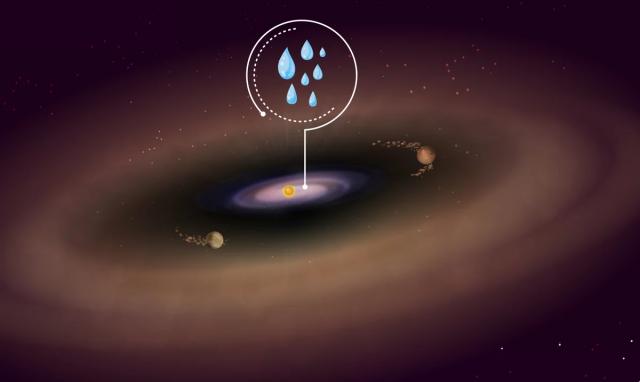
An article published in the journal “Nature” reports the discovery of water in the very young PDS 70 system. A team of researchers from the MINDS collaboration led by Giulia Perotti of the Max Planck Institute for Astronomy (MPIA) in Heidelberg, Germany, used the James Webb Space Telescope to detect the presence of water in the inner region of the protoplanetary disk surrounding the star PDS 70. Two planets were already identified in that disk and the detection of a debris cloud in a possible Trojan configuration was recently announced but there may also be rocky planets in formation on which water could play an important role in terms of habitability potential.
The image (Courtesy MPIA. All rights reserved) shows an artist’s concept of the PDS 70 system: the star is surrounded by a protoplanetary disk in which two gas giant planets are forming. In the inner area, the zone where water was detected is indicated.
The PDS 70 system continues to be of interest thanks to discoveries made using some of the most powerful astronomical instruments available. The MINDS (MIRI Mid-Infrared Disk Survey) program took advantage of the James Webb Space Telescope’s capabilities to try to identify the properties of gas and dust disks around young stars like PDS 70. It was also successful in searching for water in this forming system, one of the astronomers’ goals.
According to reconstructions of the solar system’s history, water arrived on Earth thanks to comets and asteroids. That’s because astronomers thought that water was split into its components by the radiation emitted by a young star. However, the surrounding gas and dust could act as a shield by blocking at least some of the most harmful radiation.
The discovery of water in the inner part of the PDS 70 system’s protoplanetary disk is the first of its kind. Water is in the area where rocky planets could form in that system’s habitable zone. This offers the possibility that at least some water may have been part of rocky planets since their formation.
The James Webb Space Telescope’s Mid-Infrared Instrument (MIRI) is what detected water in an area of the protoplanetary disk surrounding the star PDS 70 slightly wider than the Earth’s orbit. This water is in the form of hot steam at a temperature of about 330° Celsius.
It remains to be understood where the water detected in the PDS 70 system comes from. It could have formed in a nebula in that area or transported together with interstellar dust and gas. There are conditions where hydrogen and oxygen can combine to form water. Giulia Perotti explained that there could be a combination of these options but it’s probable that one mechanism is the decisive one. Identifying it represents the next stage in the study of this system.
The researchers plan to use the James Webb Space Telescope’s Near-Infrared Camera (NIRCam) and Near-Infrared Spectrograph (NIRSpec) instruments to obtain more information about the PDS 70 system. About 370 light-years from Earth, it’s in the cosmic neighborhood and is ideally located for observations. At this point, astronomers are particularly interested in its inner area with the hope of finding rocky planets.
