
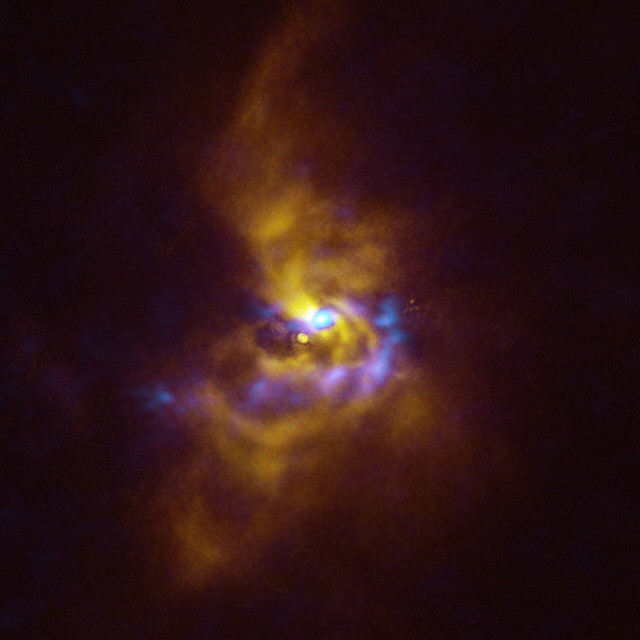
An article published in “The Astrophysical Journal Letters” reports the discovery of clumps of matter that could become planets around the young star V960 Mon. A team of researchers used the SPHERE instrument mounted on ESO’s VLT and the ALMA radio telescope, both in Chile, to examine the state of what could be a system in formation. The detection of masses estimated to be several times the Earth’s could constitute the first evidence of the formation of planets through the process of gravitational instability.
Observing systems in their formation phase, astronomers have in the past found evidence of the formation of giant planets through the mechanism of core accretion, which occurs when dust grains progressively coalesce around a core. The models point to the possibility that planets of that type also form by gravitational instability when large masses of matter collapse into a planet. This mechanism hasn’t yet been observed but it could be the process taking place around the star V960 Mon.
More than 5,000 light-years from Earth, the star V960 Mon aroused the interest of astronomers in 2014, when its brightness increased twenty-fold in a very short time. For this reason, it was classified as a FU Orionis, or FUor, star. According to the models, these changes occur when a still-forming star engulfs a mass of material from the disk of gas and dust that surrounds it.
That sort of superflare of V960 Mon led to observations conducted with various instruments over the following years. The SPHERE (Spectro-Polarimetric High-contrast Exoplanet Research) instrument was designed to directly photograph exoplanets but is also useful for obtaining images of systems in their formation phase. In the case of V960 Mon, SPHERE showed the formation of intricate spiral arms that extend over distances greater than the entire solar system.
The analysis of observations present in the ALMA radio telescope archive made it possible to integrate the SPHERE images obtaining a more complete portrait of what is happening around V960 Mon. ALMA allows to look deeper into the structures and in this case, shows that the spiral arms are fragmenting, forming clumps of matter with masses comparable to those of planets.
The observation of the clumps of matter is the first evidence of the fragmentation of a spiral arm and an indication of a gravitational instability process in the formation of planets. However, that’s not to say all clumps will become planets, and the researchers are examining the various possibilities.
Previous studies connected to models of formation via gravitational instability had already offered various possibilities. For example, clumps of matter can disintegrate due to tidal interactions with other clumps or other structures around the star, especially if they don’t cool enough to collapse into a protoplanet. An interesting possibility is that a clump is engulfed by the star and this could be the cause of the notable brightness variations of FUor stars and therefore of V960 Mon.
A possible consequence of the engulfing of a clump of matter by the star is the ejection of a secondary clump. It could end up in interstellar space becoming a so-called rogue planet or a brown dwarf, depending on the amount of material ejected. In the case of V960 Mon, the SPHERE images suggest that there may be a companion.
Observations conducted shortly after the star V960 Mon’s brightness spike suggest that it’s connected to the clumps of matter around it but are not sufficient to prove it. In the coming years, it will be possible to conduct observations with new instruments that will offer more details and information on the composition of the materials that make up gas and dust. Follow-up studies of the V960 Mon system and other FUor stars will help to better understand what processes are taking place in these young systems in formation in both the accretion of stars and in planet formation.
