August 2023

International Gemini Observatory/NOIRLab/NSF/AURA/P. Marenfeld QuasarPōniuāena

An article published in “The Astrophysical Journal Letters” reports the discovery of the most distant cold molecular gas in the interstellar medium of the galaxy that hosts the quasar nicknamed Pōniuāʻena, one of the three most distant bright quasars known. A team of researchers led by some associates of the Italian National Institute of Astrophysics (INAF) used observations conducted with the NOEMA (Northern Extended Millimeter Array) radio telescope to obtain the detection of the gas, to be precise carbon monoxide. This study can provide valuable information to understand how a supermassive black hole could have a mass 1.5 billion times the Sun’s when the universe was “only” 700 million years old.

The Crew Dragon Endurance spacecraft approaching the International Space Station in its Crew-7 mission (Image NASA TV)

A little while ago, SpaceX’s Crew Dragon Endurance spacecraft docked with the Harmony module of the International Space Station completing the first part of its Crew-7 or SpaceX Crew-7 mission that began with its launch almost 30 hours earlier. After checking that the pressure gets properly balanced, the hatch will be opened to allow Jasmin Moghbeli, Andreas Mogensen, Satoshi Furukawa, and Konstantin Borisov to enter the Station and start their mission, which will last about six months.

SpaceX's Crew Dragon Endurance spacecraft blasting off atop a Falcon 9 rocket in its Crew-7 mission (Image NASA TV)

A little while ago, SpaceX’s Crew Dragon Endurance spacecraft blasted off atop a Falcon 9 rocket from the Kennedy Space Center in its Crew-7 or SpaceX Crew-7 mission. After almost exactly twelve minutes, it successfully separated from the rocket’s last stage and went en route to carry out its mission. This is the 7th crewed mission of the Crew Dragon spacecraft within the normal rotation of the International Space Station crew. This is also the third mission for the Endurance. The launch takes place a day late because it took longer than expected to check the status of some valves of the life support system carried out after some of those of another Crew Dragon started corroding.

The Progress MS-24 cargo spacecraft approaching the International Space Station (Image NASA TV)

A few hours ago, the Progress MS-24 spacecraft docked with the International Space Station in the mission also referred to as Progress 85 or 85P. The Russian cargo spacecraft, which blasted off last Wednesday, August 24, Russian time, carries food, water, scientific experiments, fuel, and various hardware. Yesterday, the Station performed a maneuver using the Zvezda module’s engines to move from away the trajectory of a space debris but that had no consequences on the arrival of the Progress MS-24.

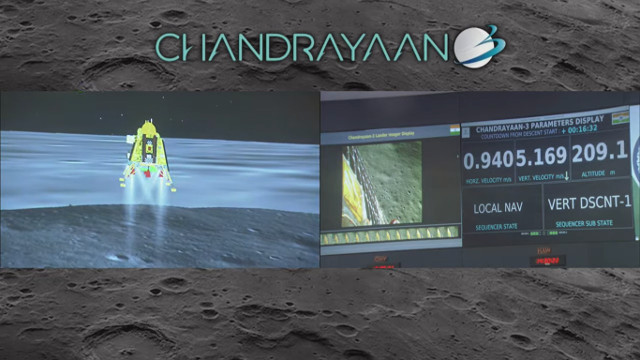
Animation of the Vikram lander and the Pragyan rover during the moon landing (on the left) and the real situation (on the right) (Image courtesy ISRO)

The Vikram lander and the Pragyan rover of the Indian mission Chandrayaan 3, launched on July 14, have successfully landed on the Moon. The idea at the Indian space agency ISRO was to replicate what was done almost exactly four years ago in the Chandrayaan 2 mission, eliminating the problems encountered on that occasion in order to achieve success. The hard lesson was learned and this time, the vehicles successfully completed the insidious maneuver of landing on the Moon. India joins the small club of nations that successfully sent a vehicle to the Moon.