ESA has published the first test images captured by the Euclid Space Telescope. As soon as Euclid reached its destination, testing of both instruments, VIS and NISP, began and will continue for a couple of months to calibrate them until they reach optimal performance. They are necessary tasks to enable Euclid to conduct the scientific mission which consists of investigating the dark universe to try to solve some cosmological mysteries such as that of the acceleration of the universe expansion.
Launched on July 1, 2023, the Euclid Space Telescope is an ESA mission with collaboration from NASA. It took almost a month to reach the so-called Lagrangian point L2, 1.5 million kilometers from Earth. Investigating cosmological mysteries in order to unravel some secrets of the universe requires instruments of adequate quality and a long calibration phase to reach those levels of quality. The first results have already sparked excitement with some mission scientists calling the images mesmerizing.
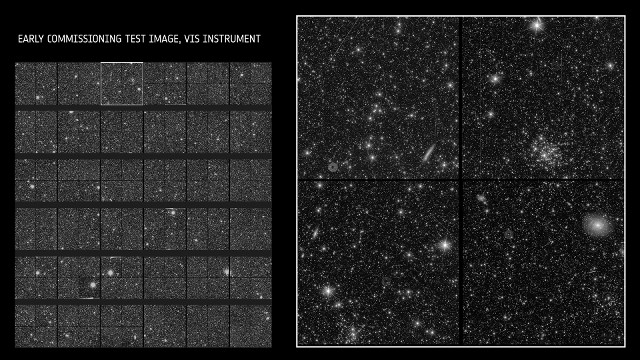
The top image (ESA/Euclid/Euclid Consortium/NASA, CC BY-SA 3.0 IGO) was captured by the VISible instrument (VIS). It shows on the left this instrument’s full field of view in visible light (550–900 nm) and on the right the zoom of one of the insets, which has an extension that is about a quarter of the Moon’s diameter. VIS required 566 seconds of light gathering to obtain this image.
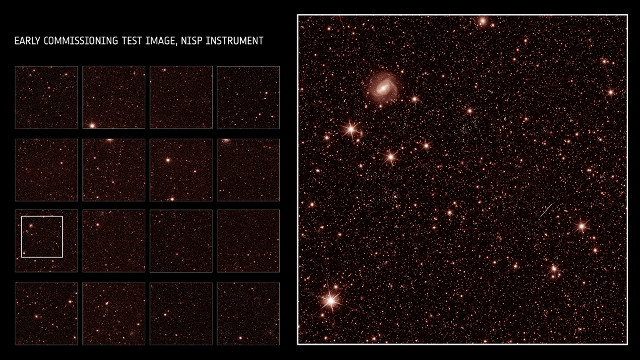
The bottom image (ESA/Euclid/Euclid Consortium/NASA, CC BY-SA 3.0 IGO) was captured by the Near-Infrared Spectrometer and Photometer (NISP) instrument. It shows on the left this instrument’s full field of view in the near-infrared (900–2000 nm) and on the right the zoom of one of the insets, which has an extension that is about a quarter of the Moon diameter. NISP required 100 seconds of light gathering to obtain this image.
Mesmerizing as they may be for Euclid mission scientists, these first images only show the results of the first tests of the instruments. This means that in the next two months, the calibration work will enable VIS and NISP to reach much higher levels of sharpness and therefore of detail. Galaxies that are still blurred will become clearly visible and their shape can be determined.
In a couple of months, the Euclid space telescope’s real scientific mission is scheduled to begin. The first images represent only cosmic snapshots but this mission aims to create a 3D map to offer new information useful for research on dark matter and dark energy. It will take time to process and analyze the data that will arrive but at stake is the solution to some secrets of the universe.