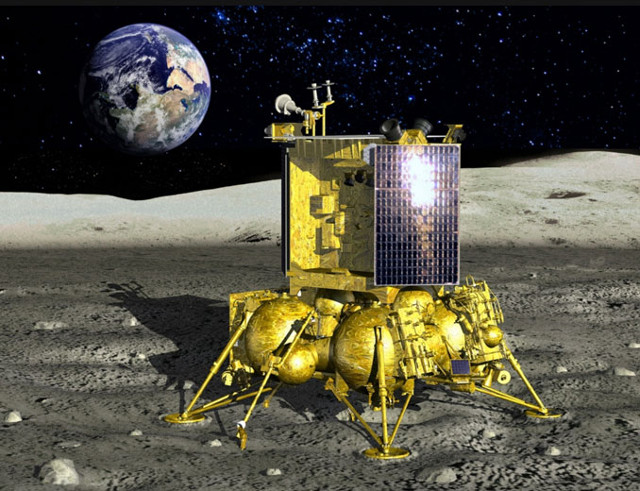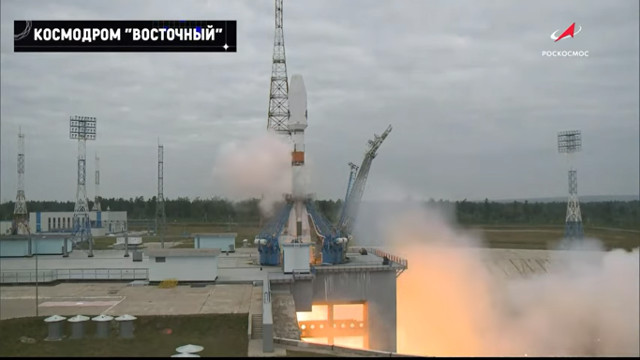
A few hours ago, the Luna 25 lander blasted off atop a Soyuz-2.1b rocket from the Russian Vostochny Cosmodrome. After about an hour, the Fregat-M last stage pushed the vehicle to leave Earth orbit, performing the maneuver called in jargon TLI (Tras Lunar Injection) which will take it towards the Moon, where it will land near the south pole, near the Boguslavsky crater.
The Luna 25 mission is the first of the Luna-Glob program, which began in the 1990s with the ambition to reprise the Soviet Luna program and develop it in a way that wasn’t possible in the 1970s. For this reason, the name is Luna 25, considering it the follow-up mission to the 1976 Luna 24.
The new program is ambitious given that the goal is to carry out increasingly complex missions up to the creation of a Russian base on the Moon. However, the problems that plagued the entire Russian space program also caused considerable delays in the start of the Luna-Glob program, which officially begins more than a decade behind the original plans.
Initially, the Luna 25 mission included a lander and a space probe but was later reduced to just the lander postponing the launch of a space probe to a later mission. First of all, there will be the testing of Moon landing technologies, the phase that other nations are still trying to successfully complete.
The lander is equipped with nine instruments that are intended to survey the surrounding terrain. There’s a scientific goal with the search for water and a monitoring of the impact of cosmic rays and radiation on the lunar soil. At the same time, the lander is intended to conduct a scouting of the area to identify the most suitable sites for the landing of the vehicles to be launched on the next missions.
For the Luna 25 mission, a relatively small lander was designed that could be launched directly toward the Moon without the need to perform long and complex maneuvers like other missions that launched far more massive vehicles. For this reason, the Moon landing is scheduled around August 21. Russia has big ambitions for its space program but they’re hampered by many problems. It has decades of experience but every new Moon vehicle must land in conditions impossible to test on Earth. In a few days, we’ll see if the Russian space agency Roscosmos managed to do an adequate job.