
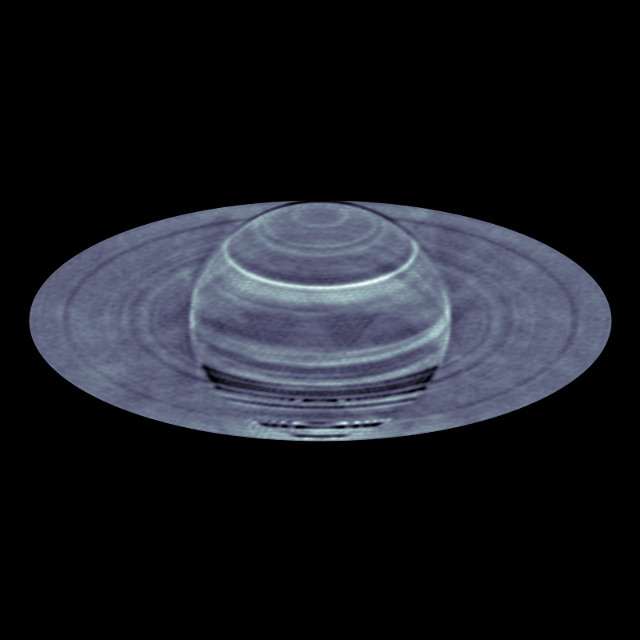
An article published in the journal “Science Advances” reports a study on the megastorms active on the planet Saturn. A team of researchers used observations conducted with the VLA (Very Large Array) that allowed them to map the radio emissions coming from under Saturn’s surface and find anomalies in the distribution of ammonia gas. The conclusions of the study are that megastorms can last even a century and leave consequences that persist in the atmosphere even longer. This also shows differences from the giant storms existing on Jupiter.
Investigating the origin of hurricanes on Saturn is difficult, in part because we know little about what goes on beneath its surface. In Jupiter’s case, the Juno mission was designed to have a space probe orbiting the planet with instruments capable of making depth measurements. To try to get useful detections from Saturn, the planet was observed on radio waves using the VLA, which allowed to capture emissions from layers below the surface.
The observations in the radio band were very useful to understand the dynamic, physical, and chemical processes taking place in Saturn’s atmosphere. These are processes such as heat transport, cloud formation, and convection in the atmosphere globally and locally. This is a technique generally used for giant gas planets that also proved to be very useful in the study of Saturn.
Megastorms occur on Saturn approximately every 20-30 years and can be considered much larger versions of the hurricanes that occur on Earth. However, on Earth, hurricanes draw energy from oceanic heat whereas this isn’t the case on Saturn. The search for the energy source behind Saturn’s megastorms led to this study, which held some surprises.
Specifically, the researchers found anomalies in the concentration of ammonia gas in Saturn’s atmosphere, which they linked to megastorms in the planet’s northern hemisphere. They expected convective currents to carry ammonia from the depths of the atmosphere to the upper layers but that’s not the case. The findings indicate that the ammonia concentration is lower at medium altitudes in the atmosphere but increases at lower altitudes, between 100 and 200 kilometers deep. According to the researchers, ammonia is transported from the upper layers of the atmosphere to the lower ones through processes of precipitation and re-evaporation. These effects can last for centuries.
The analysis of Saturn observations indicates that the tropospheric anomalies are caused by storms but that doesn’t happen on Jupiter, where similar anomalies have different causes, linked to its bands. These are significant differences that must be taken into consideration in the studies of the various gas planets. That’s true first of all in the study of the planets of the solar system but the study of the atmospheres of gas exoplanets is an expanding field, so it will be necessary to take into account the different mechanisms of origin of the storms in their study.
All these studies of storms in giant gas planets help to develop models of chaotic systems that also lead to advances in meteorology applied to Earth’s weather. For this reason, they will continue with the involvement of scientists from various disciplines.
