
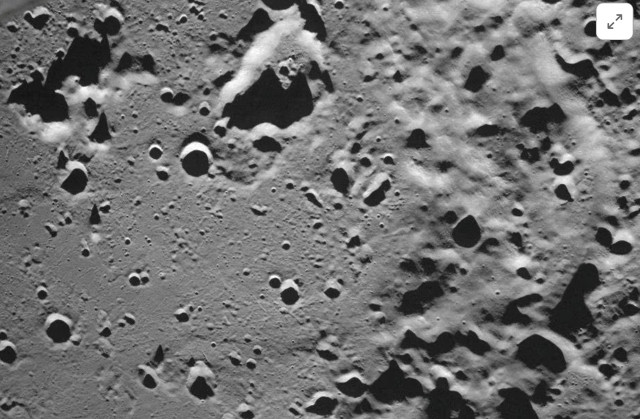
The Russian space agency Roscosmos has confirmed that its Luna 25 lander crashed on the Moon following an anomaly in one of the maneuvers that was supposed to lead to its Moon landing on Monday. The problems began on Saturday, when there was the problem and communications were lost. An examination of the telemetry data received up to that point led to the conclusion that the impulse was excessive, leading to a trajectory that caused a crash. Yet another problem in the Russian space program will bring consequences yet to be assessed in the Luna-Glob program which is based on increasingly ambitious missions for the next few years and had already accumulated years of delay.
Launched on August 11, the Luna 25 lander was supposed to represent a reprise of the Moon missions interrupted under the USSR with the aim of building a permanent base on the Moon. The Luna 25 mission started years late due to various problems that plagued all Russian space projects with the further complication that the termination of cooperation with NASA caused communication problems with the lander. Roscosmos doesn’t have a global network of stations capable of maintaining almost constant communications with its spacecraft, therefore it has blackout periods in which it’s not possible to detect the status of its own spacecraft and therefore can’t send commands in case of problems.
In the case of the Luna 25 lander, an anomalous situation was detected on August 19 after sending a command to carry out one of the maneuvers that were supposed to lead to the landing on the Moon scheduled for Monday. For reasons to be ascertained, the thrusters burn didn’t have the programmed result and consequently, there was no orbit adjustment. The subsequent blackout in communications made it impossible to attempt new sending of commands.
In the following hours, when it was already Saturday night in Russia, the failure of new attempts to communicate with the Luna 25 lander and the analysis of the available telemetry data led Roscosmos engineers to conclude that the lander had crashed on the Moon. In these cases, a commission of inquiry is immediately formed to establish the causes of the failure.
According to initial statements, Roscosmos intends to continue with the Luna-Glob program with the Luna 26 mission scheduled in 2027. It’s a space probe aimed to orbit the Moon. Whether the Luna 25 mission’s problems will have consequences remains to be seen. Even Russia, despite decades of experience, showed the difficulties that exist in Moon missions.
