August 2023

On the left, the galaxy cluster WHL0137-08 and in the inset, the galaxy nicknamed the Sunrise Arc in its distorted form, which hosts the star Earendel

Two articles, one published in “The Astrophysical Journal” and one in “The Astrophysical Journal Letters”, report various aspects of a study of Earendel, the most distant single known star. Two teams of researchers with several members in common used observations conducted with the James Webb Space Telescope to obtain new details of this star, which even such a powerful instrument could only detect thanks to a gravitational lens. Officially cataloged as WHL0137-LS, the new study turns out to be a class B blue giant, much more massive than the Sun. Webb’s observations also reveal a luminous component that could belong to a less massive companion and not even the Hubble Space Telescope was able to detect.

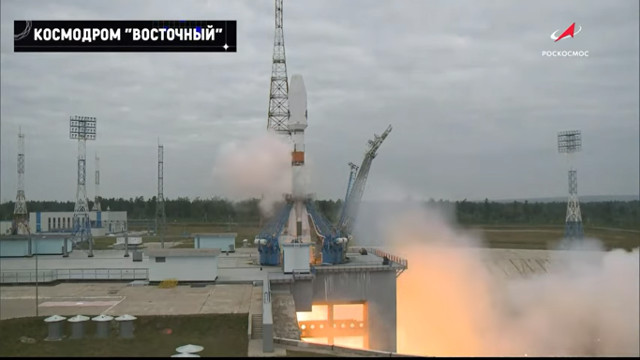
The Luna 25 lander blasting off atop a Soyuz-2.1b (Image courtesy Roscosmos)

A few hours ago, the Luna 25 lander blasted off atop a Soyuz-2.1b rocket from the Russian Vostochny Cosmodrome. After about an hour, the Fregat-M last stage pushed the vehicle to leave Earth orbit, performing the maneuver called in jargon TLI (Tras Lunar Injection) which will take it towards the Moon, where it will land near the south pole, near the Boguslavsky crater.

The Luna 25 mission is the first of the Luna-Glob program, which began in the 1990s with the ambition to reprise the Soviet Luna program and develop it in a way that wasn’t possible in the 1970s. For this reason, the name is Luna 25, considering it the follow-up mission to the 1976 Luna 24.

The Ring Nebula (Image NASA/ESA/CSA/The University of Manchester)

An image captured by the James Webb Space Telescope shows the Ring Nebula, one of the most iconic planetary nebulae, in new details that reveal the complexity of the processes taking place during the last phase of the life of a small to medium star thanks to the NIRCam (Near Infrared Camera) instrument’s ability to detect infrareds. A team of researchers led by Mike Barlow of UCL (University College London) is studying the Ring Nebula as a target of the JWST Ring Nebula Project, of which Barlow is the lead scientist. The study is still ongoing, but Barlow stated that Webb’s high-resolution images not only show details of the expanding nebula’s shell but also reveal the inner region around the central white dwarf with exquisite clarity.

One of the craters in the area called Jau

NASA celebrated the 11th anniversary of its Mars Rover Curiosity’s arrival on Mars with relief, as in recent days, the oldest rover still in operation on the red planet has just completed its most difficult ascent due to the terrain conditions. Curiosity reached an area filled with impact craters called Jau by climbing a 23° slope where there were obstacles such as slippery sand and rocks that could damage its wheels. The mission team managing route planning spent intense weeks deciding on several detours to limit danger and wear.

The Cygnus S.S. Laurel Clark cargo captured by the Canadarm2 robotic arm (Image NASA TV)

Northrop Grumman’s Cygnus spacecraft, launched last Wednesday, August 2, has just reached the International Space Station and was captured by the Canadarm2 robotic arm. Astronaut Woody Hoburg, assisted by his colleague Frank Rubio, will soon begin the slow maneuver to move the Cygnus until it docks with the Station’s Unity module after about two hours.