September 2023

The HIP 81208 system seen by SPHERE

An article published in the journal “Astronomy & Astrophysics” reports the discovery of an object that could be a gas giant planet or a brown dwarf in the HIP 81208 system. A team of researchers analyzed data from the archive of the observations conducted with the SPHERE instrument mounted on the VLT in Chile discovering an object that was cataloged as HIP 81208 Cb orbiting the smaller of the two stars in this binary system. A brown dwarf was discovered around the more massive star together with the smaller and more distant star in an analysis also published some time ago in an article in “Astronomy & Astrophysics”. The new discovery makes HIP 81208 a so-called hierarchical quadruple system, the first of its kind discovered using a direct imaging system.

The Soyuz MS-24 spacecraft blasting off atop a Soyuz-2.1a rocket (Image NASA TV)

A few hours ago, the Soyuz MS-24 spacecraft was launched from the Baikonur Cosmodrome in Kazakhstan and after a little more than three hours reached the International Space Station with three new crew members on board. It docked with the Station’s Rassvet module. As is becoming increasingly common for crewed trips as well, the ultra-fast track was used which halves the journey duration.

Oleg Kononenko and Nikolai Chub will spend about a year on the International Space Station while Loral O’Hara will spend about six months there and return to Earth with different traveling companions. Expedition 69 is almost over, as in less than two weeks, the crew members who’ve been on the Station for a year will return to Earth marking the start of Expedition 70.

A diagram illustrating the combined power of the James Webb and Hubble space telescopes in studying Cepheids present in the galaxy NGC 5584 with the NIRCam (Near-Infrared Camera) and WFC3 (Wide Field Camera 3) instruments, respectively

An article accepted for publication in “The Astrophysical Journal” reports the results of calculating the universe’s expansion rate based on the observation of Cepheids with the James Webb Space Telescope. In particular, a team of researchers led by Adam Riess used the NIRCam instrument to observe over 330 cepheids in the galaxies NGC 4258 and NGC 5584. The results are more precise than those obtained in the past with the Hubble Space Telescope but confirm the accuracy of the previous calculation of the universe’s expansion rate. This leaves open the question of the difference in results obtained with different methods.

Artist's concept of the exoplanet K2-18 b with its star in the background (Image NASA, CSA, ESA, J. Olmstead (STScI), N. Madhusudhan (Cambridge University))

An article accepted for publication in the journal “The Astrophysical Journal Letters” reports the results of a study of the exoplanet K2-18 b, including the discovery of carbon compounds such as methane in its atmosphere. A team of researchers led by Nikku Madhusudhan of the British University of Cambridge used observations conducted with the James Webb Space Telescope’s NIRISS and NIRSpec instruments to probe the atmosphere of K2-18 b. It’s an exoplanet already considered interesting due to its characteristics and its position in its planetary system’s habitable zone. Spectral analyzes also suggest the possible presence of dimethyl sulfide (DMS), a compound considered a biomarker. These are discoveries that add to the previous ones regarding an exoplanet that led to the proposal of the Hycean class.

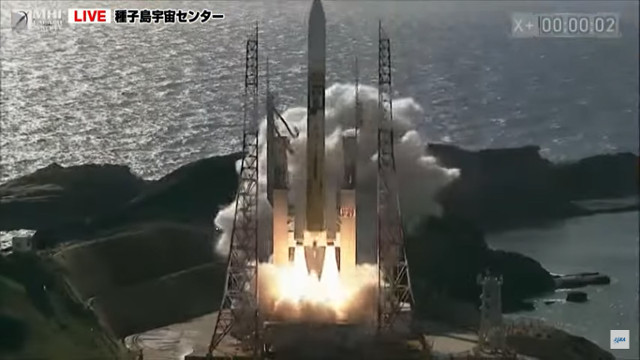
The XRISM space telescope and the SLIM Moon lander blasting off atop an H-IIA rocket (Image courtesy JAXA)

A few hours ago, the Japanese XRISM space telescope and the SLIM Moon lander were launched from the Tanegashima space center atop an H-IIA rocket. After just over 14 minutes, XRISM separated from the rocket’s last stage and after about 48 minutes, SLIM did the same. XRISM will reach low Earth orbit, where it will position at an altitude of approximately 550 kilometers. SLIM started a much longer journey.