
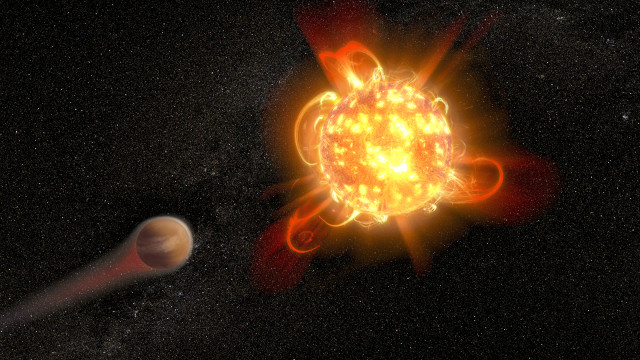
A study of flares from the star TRAPPIST-1
An article accepted for publication in “The Astrophysical Journal” reports the results of spectroscopic observations of the activity of the star TRAPPIST-1 conducted with the James Webb Space Telescope. A team of researchers observed four flares of this ultra-cool dwarf, which occurred over the course of about 27 hours. By adding data obtained with other instruments, it was possible to develop a mathematical method to separate the light of those flares from normal stellar radiation. In the study of a very small but also active star, this is very useful to improve the quality of observations of the seven rocky planets of the TRAPPIST-1 system.
