
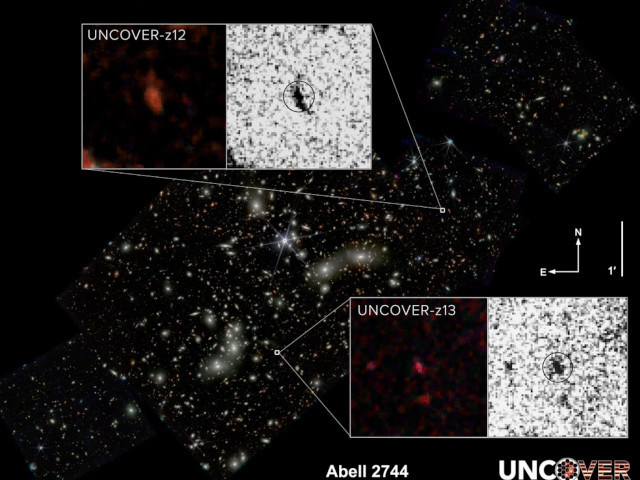
An article published in “The Astrophysical Journal Letters” reports confirmations of two primordial galaxies studied within the UNCOVER survey. A team of researchers examined spectroscopic detections obtained by the James Webb Space Telescope’s NIRSpec instrument to obtain good estimates of the distance to the galaxies UNCOVER z-13 and UNCOVER z-12. These are follow-up observations that exploited the gravitational lens generated by the Abell 2744 galaxy cluster. According to the estimates, UNCOVER z-13 is approximately 13.51 billion light-years away while UNCOVER z-12 is approximately 13.48 billion light-years away.
The image (NASA, UNCOVER (Bezanson et al., DIO: 10.48550/arXiv.2212.04026). Insets: Nasa, UNCOVER (Wang et al., 2023). Composition: Dani Zemba/Penn State. All Rights Reserved.) shows the galaxy cluster Abell 2744 and in the insets the galaxies UNCOVER z-13 and UNCOVER z-12.
Investigations of the early universe are among the James Webb Space Telescope’s primary goals. In less than two years, it has already discovered some of the oldest galaxies and others are under examination by various programs. UNCOVER (Ultradeep NIRSpec and NIRCam ObserVations before the Epoch of Reionization) is one such investigation that is exploiting the gravitational lensing generated by the Pandora Cluster, as Abell 2744 is nicknamed. A follow-up study of two primordial galaxies indicates that they are among the oldest discovered so far.
Approximately 60,000 light sources were identified in the Pandora Cluster during observations conducted with the James Webb Space Telescope during 2022. Among these, the UNCOVER survey selected 700 of them for follow-up studies and 8 were considered candidates to be among the first galaxies. The NIRCam (Near-Infrared Camera) instrument was crucial in this phase but in subsequent follow-up studies it was necessary to obtain measurements with the NIRSpec (Near Infrared Spectrograph) instrument to obtain the spectroscopic data necessary to estimate the distances of the galaxies that were studied.
The estimates obtained indicate that the galaxy UNCOVER z-13 is about 13.51 billion light-years away from Earth while UNCOVER z-12 is about 13.48 billion light-years away. This makes them the second and fourth most distant galaxies known, respectively. Unlike other early galaxies at similar distances, which look like red dots, these ones look like a peanut and a fluffy ball. They are small galaxies by the standards of recent ones but other primordial galaxies are even more compressed, to the size levels of current dwarf galaxies.
It seems that in such a remote era there was already a certain diversity among galaxies. This is crucial information for understanding the evolution that occurred in the first phase of life of those galaxies, starting with the formation of star and supermassive black holes. Studies of these primordial galaxies continue to reconstruct the initial part of the history of the universe.
