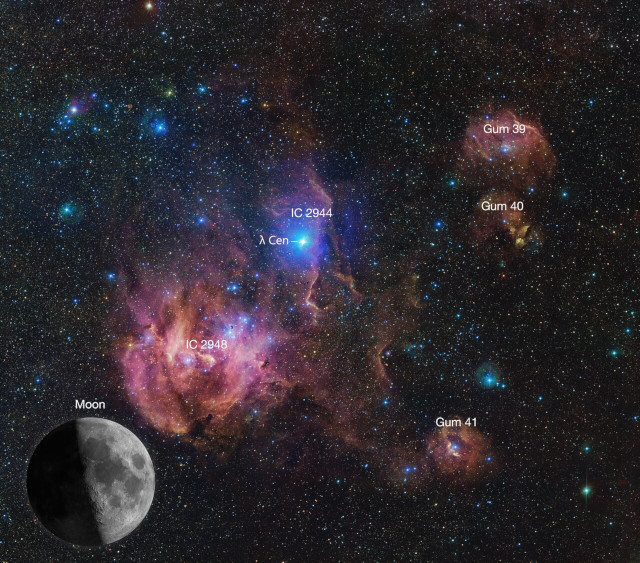
An image (ESO/VPHAS+ team. Acknowledgement: CASU) captured by the VLT Survey Telescope (VST) shows a cosmic formation nicknamed the Running Chicken for the shape some see in what is actually a collection of different star-forming regions. The OmegaCAM wide-field camera mounted on the VST generated a 1.5 billion-pixel image that includes never-before-seen detail in an area 25 times the size of the full Moon. The brightest region in the nebula is cataloged as IC 2948 and corresponds to what some see as the chicken’s head and others as its rear end. Towards the center of the image, at a pillar-like structure, there’s a region cataloged as IC 2944. The brightest star is actually closer and is known as Lambda Centauri.
The VST is a telescope of the Italian National Institute for Astrophysics at ESO’s Cerro Paranal Observatory in Chile and the OmegaCAM allows to capture extremely detailed images. During the VST Photometric Hα Survey of the Southern Galactic Plane and Bulge (VPHAS+), which aims to study the life cycle of stars, it was used to capture a series of images which were assembled to include all of the area nicknamed the Running Chicken.
The star-forming regions that form the Running Chicken are about 6,500 light-years away from Earth. The pink hues in the image are due to hydrogen becoming bright due to ultraviolet radiation emitted by young stars in that area.
The brightest region in Running Chicken is cataloged as IC 2948 and corresponds to what some see as the chicken’s head and others as its rear end. Plumes of gas and dust are visible as thin pastel outlines.
Towards the center of the image, in correspondence with a structure that looks like a sort of pillar, there’s a region cataloged as IC 2944. It’s also called Lambda Centauri Nebula after the star that apparently is part of it but actually that star with a mass about 4.5 times the Sun’s is much closer, “only” 420 light-years from Earth.
The IC 2948 and IC 2944 regions host young stars that emit strong radiation that ionizes the surrounding hydrogen, making it glow. However, that radiation damages that environment resulting in further star formation being inhibited over time.
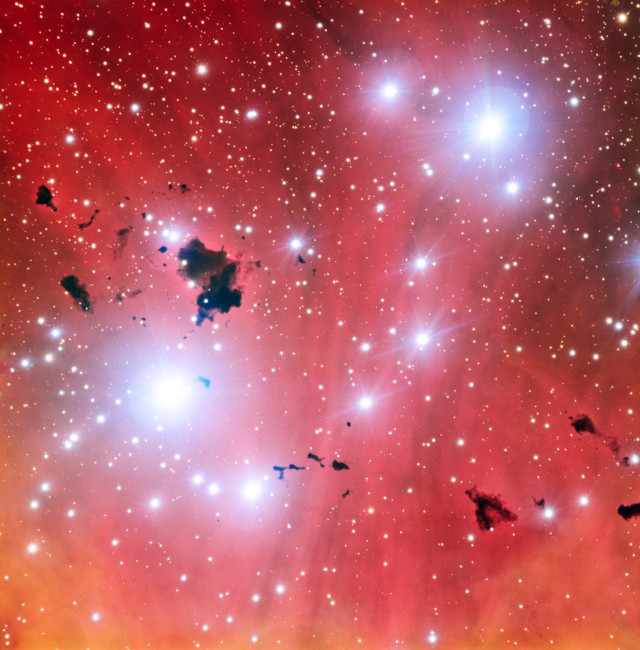
Some regions called Bok globules are not affected as much by ultraviolet radiation as nearby stars and as a result, appear darker in the bottom image showing IC 2944. That’s an image captured by the Very Large Telescope (VLT), another ESO telescope at Cerro Paranal. The globules within IC 2944 were discovered by astronomer A. David Thackeray and are therefore also known as Thackeray globules.
The top image showing the Running Chicken also includes other regions cataloged as Gum 39, Gum 40, and Gum 41. These are some of the regions discovered by astronomer Colin Stanley Gum and included in his catalog of emission nebulae, named after the light emitted, with colors that vary depending on the intensity of the radiation that hits the gas inside them.
The mosaic of photos taken by OmegaCAM offers new details of the stars present throughout the region. They are young stars of diverse masses that can reveal new details of the early stages of their lives. That’s why it’s a region that kept on being studied for a long time with different instruments.