2023

One of the craters in the area called Jau

NASA celebrated the 11th anniversary of its Mars Rover Curiosity’s arrival on Mars with relief, as in recent days, the oldest rover still in operation on the red planet has just completed its most difficult ascent due to the terrain conditions. Curiosity reached an area filled with impact craters called Jau by climbing a 23° slope where there were obstacles such as slippery sand and rocks that could damage its wheels. The mission team managing route planning spent intense weeks deciding on several detours to limit danger and wear.

The Cygnus S.S. Laurel Clark cargo captured by the Canadarm2 robotic arm (Image NASA TV)

Northrop Grumman’s Cygnus spacecraft, launched last Wednesday, August 2, has just reached the International Space Station and was captured by the Canadarm2 robotic arm. Astronaut Woody Hoburg, assisted by his colleague Frank Rubio, will soon begin the slow maneuver to move the Cygnus until it docks with the Station’s Unity module after about two hours.

The Cygnus S.S. Laurel Clark cargo spacecraft blasting off atop an Antares rocket (Photo NASA/Terry Zaperach)

A few hours ago, Northrop Grumman’s Cygnus spacecraft blasted off atop an Antares rocket from the Mid-Atlantic Regional Spaceport (MARS), part of NASA’s Wallops Flight Facility (WFF) on Wallops Island. After about nine minutes it successfully separated from the rocket’s last stage and went en route to its destination. This is the mission called NG-19 or CRS NG-19 to transport supplies to the International Space Station for NASA.

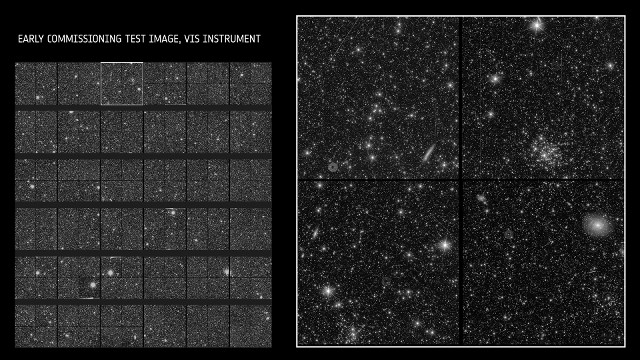
Early commissioning test image – VIS instrument full field of view and zoom in for detail

ESA has published the first test images captured by the Euclid Space Telescope. As soon as Euclid reached its destination, testing of both instruments, VIS and NISP, began and will continue for a couple of months to calibrate them until they reach optimal performance. They are necessary tasks to enable Euclid to conduct the scientific mission which consists of investigating the dark universe to try to solve some cosmological mysteries such as that of the acceleration of the universe expansion.

The Herbig-Haro 46/47 object

An image captured by the James Webb Space Telescope portrays Herbig-Haro 46/47, or simply HH 46/47, a nebula of ionized gas that emits a faint light in which two lobes are very bright instead. The two numbers are due to the fact that there are two young stars still growing in the middle of a disk of gas and dust. Webb’s NIRCam (Near-Infrared Camera) instrument captured details of that area never seen before. The nebula is invisible at optical frequencies and is blue at infrared. The most spectacular part is the one characteristic of the Herbig-Haro objects with the ionized stellar winds forming two lobes visible in the image in orange hues.