2023

The so-called ultradeep field used in the MIDIS survey and on the right, some of the primordial galaxies at the center of this study are highlighted in the circle

An article published in “The Astrophysical Journal Letters” reports a study indicating that the early universe was much brighter than predicted by simulations based on current cosmological models. A team of researchers coordinated by the Center for Astrobiology (CAB) in Madrid, Spain, used observations conducted with the James Webb Space Telescope to examine galaxies that formed between 200 and 500 million years after the Big Bang. The combination of observations conducted with the NIRCam instrument and the MIRI Deep Imaging Survey (MIDIS) of the Hubble Ultra Deep Field (HUDF) on a sample of 44 primordial galaxies shows their surprising brightness and compactness.

The Euclid Space Telescope blasting off atop a Falcon 9 rocket (Image courtesy SpaceX)

A little while ago, ESA’s Euclid Space Telescope was launched atop a SpaceX Falcon 9 rocket from Cape Canaveral. After just over 40 minutes, it successfully separated from the rocket’s last stage and entered its course that will take it towards the so-called L2 point, about 1.5 million kilometers from Earth, where its scientific mission will begin with an investigation of the dark universe.

The Euclid Space Telescope mission is focused on the cosmological mysteries connected to dark matter and dark energy. Cosmological research in recent decades indicates that the universe we see with the ordinary matter that forms galaxies constitutes only a small part of the cosmos. Astronomers and physicists are having difficulty investigating parts of the cosmos that we can neither see nor directly detect. It’s a problem that makes it difficult to test models that try to explain the effects that led to hypothesize the existence of dark matter and dark energy. For this reason, ESA developed a scientific mission focused on these cosmological problems.

The Dragon cargo spacecraft departing the International Space Station to end its CRS-28 mission (Image NASA TV)

A little while ago, SpaceX’s Dragon spacecraft ended its CRS-28 (Cargo Resupply Service 28) mission for NASA splashing down smoothly off the Florida Coast. The Dragon left the International Space Station about 22 hours earlier. For SpaceX, this was the 8th mission of the 2nd contract with NASA to transport supplies to the Station with the new version of the Dragon cargo spacecraft.

Shortly after the splashdown, SpaceX’s recovery ship went to retrieve the Dragon to transport it to the coast. The cargo brought back to Earth will be delivered to NASA within a few hours. The Dragon spacecraft reached the International Space Station on June 6, 2023.

Diagram of Earth as a detection center for very low-frequency gravitational waves emitted by pairs of supermassive black holes (top) using pulsars (bottom) (Image courtesy EPTA)

A series of articles published or being published in the journals “Astronomy and Astrophysics” and “The Astrophysical Journal Letters” reports various aspects of the detection of very low-frequency gravitational waves. Researchers from the European Pulsar Timing Array (EPTA), the Indian Pulsar Timing Array (InPta), the Parkes Pulsar Timing Array (PPTA), the Chinese Pulsar Timing Array (CPTA), and the North American Nanohertz Observatory for Gravitational Waves (NanoGrav) analyzed data collected over the course of more than 25 years using groups of pulsars to obtain a kind of detector of gravitational waves at the galactic level. This was possible by exploiting the extreme regularity of the signals emitted by pulsars to detect variations of less than a millionth of a second and their correlations to identify gravitational waves. This technique expands the gravitational-wave astronomy opened up by the LIGO and Virgo detectors since the announcement of the first detection in February 2016.

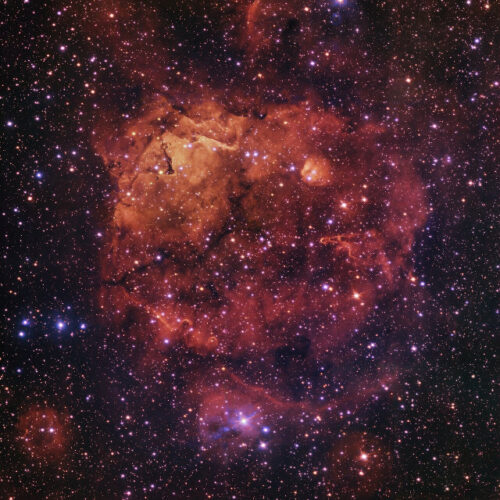
The nebula Sh2-284 (Image ESO/VPHAS+ team. Acknowledgement: CASU)

An image captured by the OmegaCAM instrument mounted on ESO’s VST in Chile shows details of the nebula cataloged as Sh2-284. It’s part of the VST Photometric Hα Survey of the Southern Galactic Plane and Bulge (VPHAS+), a survey that included over 500 million objects in the Milky Way to improve our understanding of stars’ life cycles. Sh2-284 is a sort of star nursery whose shape was compared to that of a cat’s face and for this nicknamed “smiling cat”.