2023

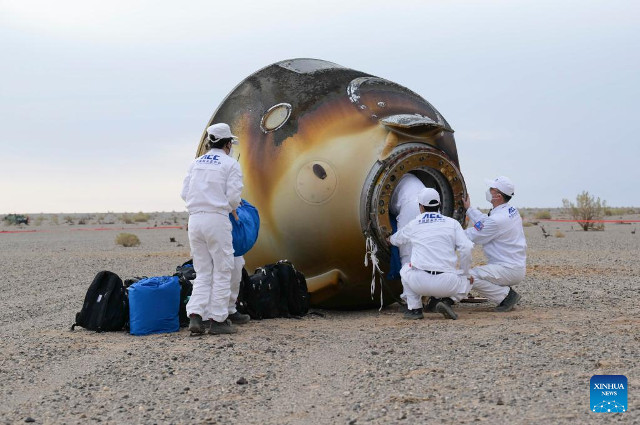
The Shenzhou 15 capsule after its landing (Photo courtesy Xinhua/Li Zhipeng)

A few hours ago, the three Chinese taikonauts of the Shenzhou 15 mission returned to Earth after spending a little more than six months on the Chinese space station Tiangong. The three taikonauts Fei Junlong, Deng Qingming, and Zhang Lu had left the station a few hours earlier to land at a site called Dongfeng in China’s Inner Mongolia Autonomous Region. A procedure that significantly reduces the time to return to Earth already tested in the past worked again and is becoming routine.


An artist's impression of the exoplanet WASP-18b and the spectrum of thermal emissions detected by the James Webb Space Telescope's NIRISS instrument at wavelengths between 0.85 and 2.8 microns

An article published in the journal “Nature” reports the results of an examination of the exoplanet WASP-18b. A team of researchers used the James Webb Space Telescope to map the temperatures on the surface of this ultra-hot Jupiter very close to its star. The temperature variations are around 1,000° Kelvin between the hottest area always facing its star and the border area between day and night. Webb’s Near-Infrared Imager and Slitless Spectrograph (NIRISS) also found traces of water vapor that other instruments had missed.

The Crew Dragon Freedom spacecraft recovered at the end of its Ax-2 mission (Photo courtesy SpaceX)

A few hours ago, SpaceX’s Crew Dragon Freedom spacecraft concluded its Ax-2 mission by splashing down without problems. On board were Peggy Whitson, Ali AlQarni, John Shoffner, and Rayyanah Barnawi, who ended this completely private space mission in the Atlantic Ocean after leaving the International Space Station about 12 hours earlier. Shortly after splashing down, SpaceX’s recovery ship went to retrieve the Freedom and its crew to transport them to the coast.

The Shenzhou 16 mission starting with the launch atop a Long March-2F rocket (Photo courtesy Xinhua/Li Gang)

A confirmation has arrived that three Chinese taikonauts from the Shenzhou 16 mission reached the Chinese space station Tiangong with an automated docking maneuver. They blasted off about seven hours earlier on a Long March-2F rocket from the Jiuquan Satellite Launch Center. They form the fifth crew of the Chinese space station and will remain there for about six months, the standard duration for a mission.

The Progress MS-23 cargo spacecraft approaching the International Space Station (Image NASA TV)

A few hours ago, the Progress MS-23 spacecraft blasted off atop a Soyuz 2.1a rocket from the Baikonur Cosmodrome in Kazakhstan. After about nine minutes it successfully separated from the rocket’s last stage and was placed on its ultra-fast track in its resupply mission to the International Space Station also called Progress 84 or 84P. After almost 3.5 hours it reached the International Space Station docking with its Poisk module. The ultra-fast track requires very precise maneuvering and a favorable position of the Station. For this reason, it wasn’t used in the previous two Russian resupply missions.