2023

The infrared variations seen by a ground-based telescope in Jupiter's North Equatorial Belt between May 2001 and December 2011.

An article published in the journal “Nature Astronomy” reports a solution to the mystery of the change in color of some belts of the planet Jupiter’s atmosphere. A team of researchers used data collected by NASA’s Juno space probe to link those changes to the planet’s magnetic field. Scientists already knew the connection with variations in the infrared band, which means the propagation of electromagnetic field energy, about 50 kilometers below Jupiter’s surface. This new study brings evidence that the variations may in turn be caused by waves produced by the planetary magnetic field at depth.

The Crew Dragon Freedom spacecraft begins the Ax-2 mission blasting off atop a Falcon 9 rocket (Image NASA TV)

A little while ago, SpaceX’s Crew Dragon Freedom spacecraft docked with the International Space Station’s Harmony module performing the first part of its private mission Axiom Mission 2 or simply Ax-2. It blasted off atop a Falcon 9 rocket from the Kennedy Space Center when it was afternoon in the USA. After verifying that the pressure is properly balanced, the hatch will be opened to allow crew members to enter the Station.

A little bit more than one year after the Ax-1 mission, a new collaboration between public entities, which this time besides NASA includes the Saudi Space Commission, and private ones, sent new astronauts to the International Space Station to conduct a series of scientific experiments on behalf of entities that generally can’t carry out studies in microgravity conditions.

The Lupus 3 molecular cloud

An image captured by the Dark Energy Camera (DECam) at the Cerro Tololo Observatory in Chile shows the star-forming interstellar cloud cataloged as Lupus 3. Full of activity, it contains protostars that are literally breaking out of their cocoon of gas and dust such as HR 5999 and HR 6000, in the center of the image. The light of those very young stars illuminates the reflection nebula cataloged as Bernes 149. This area is in the cosmic neighborhood, so it’s observed all the time, sometimes obtaining breathtaking images of newborn stars and protostars.

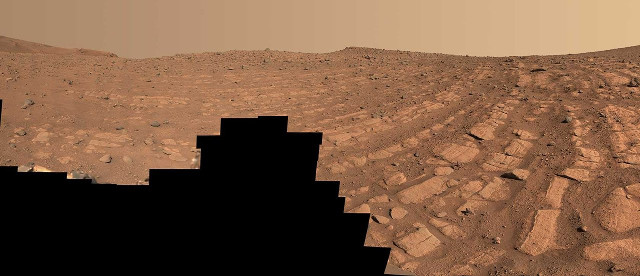
Skrinkle Haven on Mars (Image NASA/JPL-Caltech/ASU/MSSS)

Images captured by the Mars Rover Perseverance in an area nicknamed Skrinkle Haven in Jezero Crater on Mars indicate the presence of a river that flowed into that crater in ancient times. The surprise is that the layers of sediments and pebbles that form what was called a curvilinear unit suggest that that river was deeper and more powerful than all other ancient Martian rivers identified so far. A hill nicknamed Pinestand about 450 meters from Skrinkle Haven may have been formed by a powerful river but scientists are assessing other explanations as well.

Artist impression of a black hole accretion (Image courtesy John A. Paice)

Two articles, one published in the journal “Monthly Notices of the Royal Astronomical Society” and one in “The Astrophysical Journal Letters”, report as many studies on what was defined as the largest cosmic explosion ever detected. Two teams of researchers studied the data collected with various instruments regarding the event cataloged as AT2021lwx offering two different hypotheses for its cause. Both teams believe that a supermassive black hole about 8 billion light-years from Earth caused that explosion but disagree on what triggered it: one team points to a cloud of gas and dust being violently swallowed while the other team points to a tidal disruption event where a star being devoured.