
2023

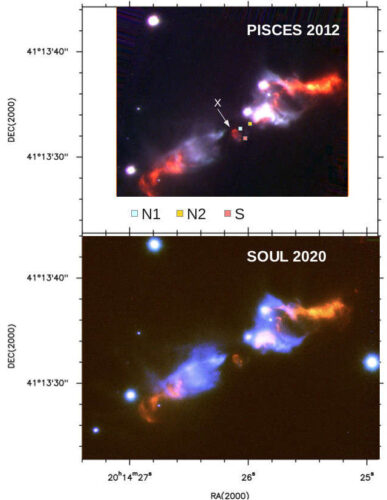
Photographs of the protostar IRAS20126+4104 and its material jets taken in 2012 and 2020 using the FLAO/PISCES and SOUL/LUCI1 instruments

An article published in the journal “Astronomy & Astrophysics” reports a study on the massive protostar cataloged as IRAS20126+4104 which obtained the measurement of the speed of the jets of materials that are ejected at about 100 km/h. A team of researchers led by Fabrizio Massi of the Italian National Institute of Astrophysics in Arcetri used the SOUL instrument installed on the Large Binocular Telescope (LBT) to obtain the details necessary to measure the displacements that occurred with respect to archive images dating back to 2003 and 2012. This result helps to better understand the formation processes of massive stars.

The Soyuz MS-22 spacecraft departing the International Space Station (Image NASA TV)

A little while ago, the Soyuz MS-22 spacecraft landed in Kazakhstan after departing the International Space Station almost two hours earlier. Generally, the staff arrives shortly after to assist the crew who have just returned from the Station but in this case, there’s no one on board due to the problems encountered in December 2022 with the cooling system, which made the journey unsafe for the humans.

Ryugu, the Hayabusa 2 space probe and the molecules of uracil and vitamin B3

An article published in the journal “Nature Communications” reports the discovery of uracil, one of the bases of RNA, and niacin, i.e. vitamin B3, in the samples of asteroid Ryugu brought back to Earth by the Japanese Hayabusa 2 space probe. A team of researchers led by Yasuhiro Oba of Japan’s Hokkaido University developed an analytical technique to identify compounds in concentrations between parts per billion and parts per trillion to analyze just over 5 grams of samples.

The star WR 124 as seen by the James Webb Space Telescope (Image NASA, ESA, CSA, STScI, Webb ERO Production Team)

An image captured by the James Webb Space Telescope shows the star WR 124 and the surrounding nebula in never-before-seen detail. This is a case where a star is nearing the end of its life, which could culminate in a supernova. For this reason, astronomers have been keeping an eye on WR 124 for years with various instruments and it was among Webb’s first observation targets in June 2022. The very powerful stellar wind typical of so-called Wolf-Rayet stars caused the loss of this star’s outer layers, which formed the nebula that surrounds it. Its details have now been captured in the breathtaking image thanks to Webb’s NIRCam and MIRI instruments to better understand the processes taking place before the possible supernova or another type of death.

The Dragon cargo spacecraft about to dock with the International Space Station in its CRS-27 mission (Image NASA TV)

A little while ago, SpaceX’s Dragon 2 spacecraft docked with the International Space Station’s Harmony module completing the first part of its CRS-27 mission. Astronaut Woody Hoburg monitored the operation, but the cargo spacecraft, which blasted off when it was Tuesday in the USA, completed the maneuvers automatically without any problem. Actually, it arrived about 20 minutes earlier than scheduled.