2023

The Soyuz MS-23 spacecraft approaching the International Space Station (Image NASA TV)

A few hours ago the Soyuz MS-23 spacecraft docked with the International Space Station. It blasted off on Friday, February 24, with the aim to replace the Soyuz MS-22, which use in safety conditions was made impossible by a failure in its cooling system. Now the mission of Dmitri Petelin, Frank Rubio, and Sergey Prokopyev could be extended for a total duration of about a year using the Soyuz MS-23 to enable them to come back to Earth.

The Soyuz MS-23 spacecraft blasting off atop a Soyuz-2.1a rocket (Image NASA TV)

A few hours ago, the Soyuz MS-23 spacecraft blasted off atop a Soyuz-2.1a rocket from the Baikonur Cosmodrome, Kazakhstan. After about nine minutes it successfully separated from the rocket’s last stage and was placed on its route, which requires about two days of journey. It replaces the damaged Soyuz MS-22 as a vehicle for the return of its three crew members: Dmitri Petelin, Frank Rubio, and Sergey Prokopyev. This is the solution chosen by the Russian Roscosmos space agency after having established the impossibility of using the Soyuz MS-22 for the return journey with a crew on board in safety conditions.

Mirabilis, Elstir and Vinteuil in a combination of X-ray and optical frequency observations

An article being published in “The Astrophysical Journal” reports the results of the study of two galaxy mergers between dwarf galaxies with active galactic nuclei. A team of researchers used data collected by NASA’s Chandra X-ray Observatory to discover candidates and then compared them with infrared observations conducted with NASA’s WISE Space Telescope and optical frequency observations conducted with the Canada-France-Hawaii Telescope (CFHT).

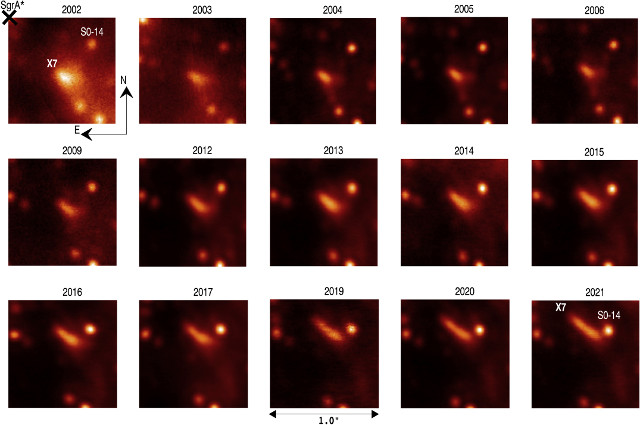
Some images captured by the NIRC2 instrument using adaptive optics showing the evolution of X7 between 2002 and 2021

An article published in “The Astrophysical Journal” reports the results of twenty years of observations of a giant filament of gas and dust that is progressively approaching Sagittarius A*, the supermassive black hole at the center of the Milky Way. A team of researchers from the Keck Observatory and UCLA’s Galactic Center Orbits Initiative (GCOI) used Keck’s OSIRIS and NIRC2 instruments to keep an eye on this filament, cataloged as X7, to study its orbit and shape’s evolution. According to predictions, in 2036, X7 will get close to Sagittarius A* to the point of dissipating and be devoured. This will be a really interesting event to study even more deeply what happens in that really extreme environment.

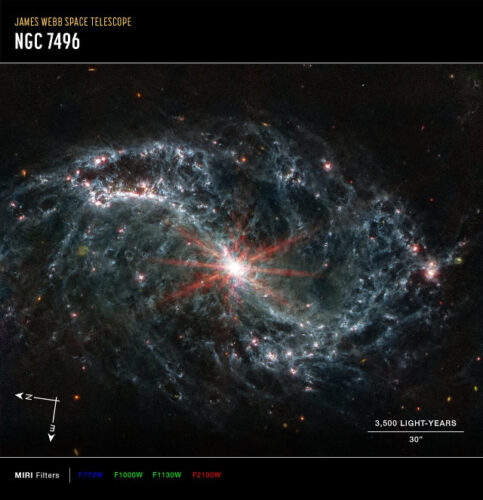
The galaxy NGC 7496 as seen by the James Webb Space Telescope (Image NASA, ESA, CSA, and J. Lee (NOIRLab), A. Pagan (STScI))

A special issue of “The Astrophysical Journal Letters” contains a series of articles reporting the first results of the PHANGS–JWST survey. More than one hundred researchers from the Physics at High Angular resolution in Nearby Galaxies (PHANGS) Collaboration used the James Webb Space Telescope to examine the galaxies M74, NGC 7496, IC 5332, NGC 1365, and NGC 1433. In particular, the Mid-Infrared Instrument (MIRI) made it possible to observe structures within those galaxies in previously unseen detail. The information gathered is valuable for reconstructing star formation processes and the influence they have on the gas surrounding protostars and newborn stars.