2023

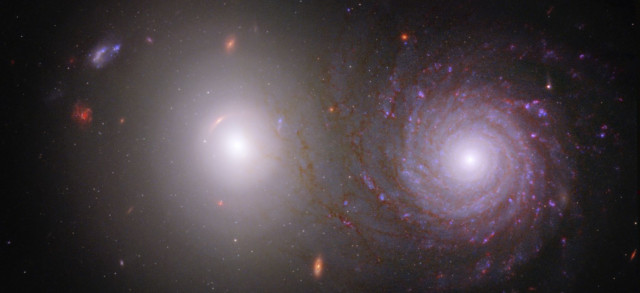
An elliptical galaxy on the left and a spiral galaxy on the right

An article published in the journal “Nature Astronomy” provides an explanation for the scarcity of spiral galaxies in the so-called Supergalactic Plane. A team of researchers used results obtained from the SIBELIUS supercomputer simulation to offer an explanation based on galaxy mergers. The analysis of the results indicates that in galaxy clusters present on the Supergalactic Plane, interactions and mergers are common with the result that spiral galaxies merge to become elliptical galaxies. Far from the Supergalactic Plane, galaxies are more isolated and therefore less likely to merge.

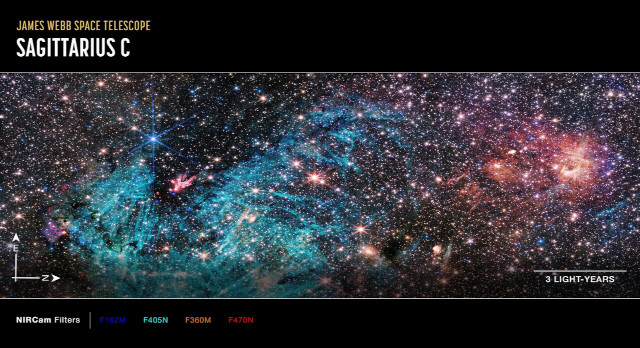
The area cataloged as Sagittarius C

An image captured with the James Webb Space Telescope shows a star-forming area cataloged as Sagittarius C just 300 light-years away from Sagittarius A*, the supermassive black hole at the center of the Milky Way. In the heart of the galaxy, among half a million stars, there’s a cluster of protostars in the middle of a cloud so dense that the stars behind it are obscured even to the most powerful existing telescope. In contrast, protostars are visible to the NIRCam instrument in detail along with cosmic features that were previously unknown and astronomers have yet to identify.

Super Heavy Booster 8 and Starship 25 blasting off (Image courtesy SpaceX)

SpaceX conducted a new flight test of its Super Heavy rocket and Starship prototypes, launched from its base in Boca Chica, Texas. This is the second test involving the entire system of Elon Musk’s company which is supposed to revolutionize space travel with an unprecedented transport capacity and being totally reusable. In this case, however, they are prototypes with the Super Heavy identified as Booster 9 and the Starship identified as Starship 25 or Ship25 or simply S25. Despite the upgrades, they don’t have the safety requirements required to conduct controlled landings. After the first test conducted on April 20, many changes were made to the Super Heavy and Starship systems but also to the launch pad.

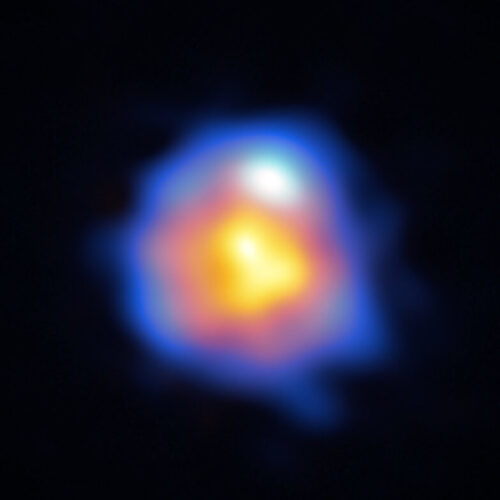
The star R Leporis as seen by the ALMA radio telescope

An article published in “The Astrophysical Journal” reports the results of observations of the star R Leporis conducted using the ALMA radio telescope with its receivers at their highest frequencies and an antenna array configuration spread over an area with a diameter of 16 kilometers. R Leporis, or simply R Lep, is a so-called carbon star, a red giant whose atmosphere is particularly rich in carbon in a phase in which oxygen is normally in greater quantities. Unprecedented observations made it possible to detect details of a natural maser around a star that is reaching the end of its life.

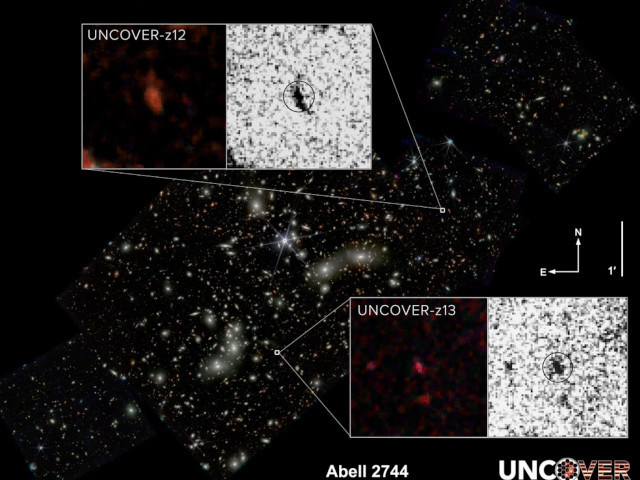
The galaxy cluster Abell 2744 and in the insets the galaxies UNCOVER z-13 and UNCOVER z-12.

An article published in “The Astrophysical Journal Letters” reports confirmations of two primordial galaxies studied within the UNCOVER survey. A team of researchers examined spectroscopic detections obtained by the James Webb Space Telescope’s NIRSpec instrument to obtain good estimates of the distance to the galaxies UNCOVER z-13 and UNCOVER z-12. These are follow-up observations that exploited the gravitational lens generated by the Abell 2744 galaxy cluster. According to the estimates, UNCOVER z-13 is approximately 13.51 billion light-years away while UNCOVER z-12 is approximately 13.48 billion light-years away.