2023

A set of what are called super images that show Io's volcanic hot spots at different times when this moon was subject to observations

An article published in the journal “Geophysical Research Letters” reports the most accurate map created so far of the volcanoes of Io, one of the planet Jupiter’s Galilean moons. A team of researchers led by Francesca Zambon of the Italian National Institute of Astrophysics used data collected by the Juno space probe’s JIRAM instrument in a NASA mission that also sees the collaboration of the Italian Space Agency regarding JIRAM. The surveys made it possible to identify 242 volcanic hot spots, 23 of which had not been previously detected. The new hot spots were identified mainly in the polar regions, an achievement possible thanks to Juno’s orbit.

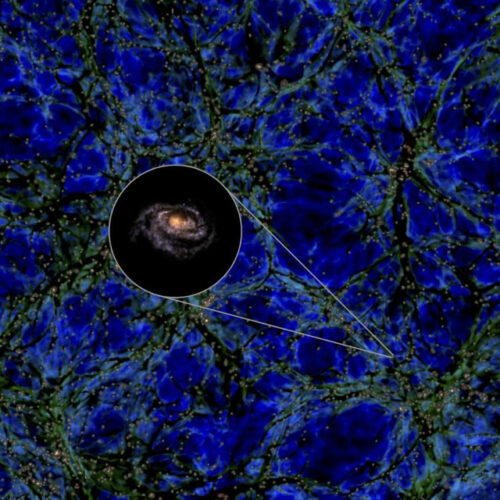
An image of the Milky Way superimposed on that of galaxies (represented as yellow dots) simulated in the IllustrisTNG project immersed in dark matter (in green and blue)

An article published in the journal “Monthly Notices of the Royal Astronomical Society” reports the results of a study that indicates that the Milky Way is abnormally massive in relation to the so-called Local Sheet, the group of galaxies that surround it. A team of researchers used simulations conducted within the IllustrisTNG project and discovered that a galaxy in the same situation as the Milky Way should be much smaller than the cosmic wall that surrounds it. The simulations indicate that there’s one exception for every million galaxies in IllustrisTNG under the same conditions. This must be kept in mind in studies of galactic environments.

The map of the polarized microwave emission measured by the QUIJOTE experiment

Six articles published in the journal “Monthly Notices of the Royal Astronomical Society” report various aspects of the most accurate mapping of the polarization of the Milky Way’s microwave emissions. This provides a map of the galactic magnetic field thanks to the QUIJOTE (Q-U-I JOint TEnerife) experiment. The QUIJOTE Collaboration presented what is only the initial set of scientific papers in a survey that complements the ones obtained from other missions such as the one from the Planck Surveyor satellite. These results are useful to obtain new information on the structure of the Milky Way’s magnetic field and to understand the energetic processes that occurred soon after the birth of the universe.

A mosaic of 690 frames obtained with Webb's Near Infrared Camera (NIRCam) instrument which constitutes one of the first images of the CEERS survey and shows in the insets some examples of primordial galaxies

An article accepted for publication in “The Astrophysical Journal” reports the results of a study of the structure and morphology of galaxies that existed in the first three billion years of life of the universe. A team of researchers used observations conducted with the James Webb Space Telescope as part of the CEERS survey to obtain enough detail to understand what primordial galaxies were like. The conclusion is a confirmation of previous research regarding the remarkable variety of shapes and structures and turned out even superior thanks to Webb. In many of them, the structures are already quite evolved, as in closer and younger galaxies.

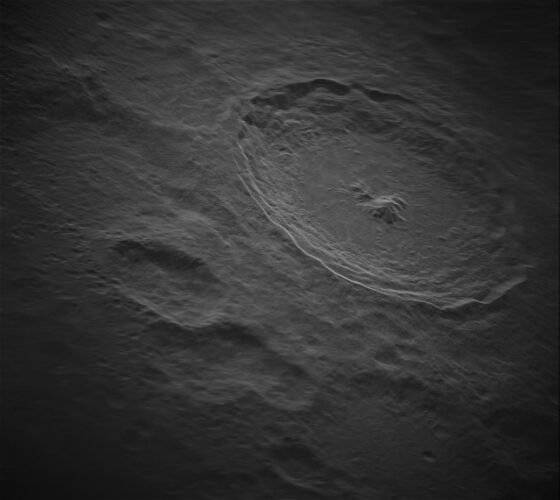
Radar image of Tycho Crater on the Moon (Image NRAO/AUI/NSF)

A new image of Tycho’s crater on the Moon is the most detailed yet captured from Earth. A collaboration between Green Bank Observatory (GBO), National Radio Astronomy Observatory (NRAO), Raytheon Intelligence & Space (RI&S), and Green Bank Telescope (GBT) produced the image thanks to a new radar technology that greatly improved astronomical applications of radars. Images of the lunar surface are just the beginning because other objects can be examined to create far more detailed images than radars could before. This result can be achieved with low-power radar transmitters.