
2023

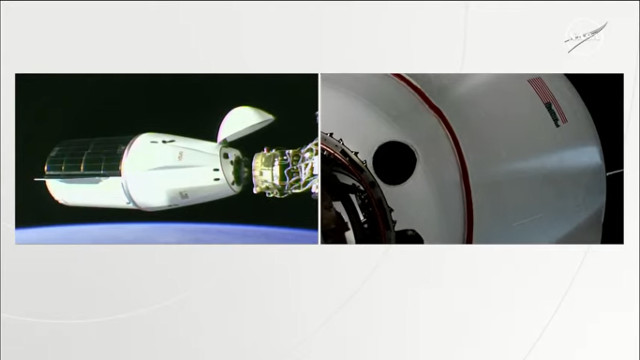
The Dragon 2 cargo spacecraft docking with the International Space Station in its CRS-29 mission (Image NASA TV)

A little while ago, SpaceX’s Dragon 2 spacecraft docked with the International Space Station’s Harmony module completing the first part of its CRS-29 mission. Astronauts Jasmin Moghbeli and Loral O’Hara monitored the operation but the cargo spacecraft, which blasted off when it was Thursday night in the USA, completed the maneuvers automatically without any problem.

The CRS-29 mission will end in about a month with the return to Earth. The second version of the Dragon cargo spacecraft can stay in space much longer than the first version but for now, NASA hasn’t extended its missions.

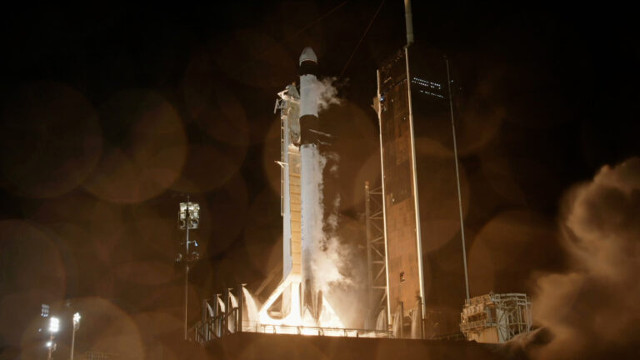
SpaceX Dragon 2 cargo spacecraft stars its CRS-29 mission blasting off atop a Falcon 9 rocket (Photo NASA)

A few hours ago, the SpaceX Dragon 2 spacecraft blasted off atop a Falcon 9 rocket from the Kennedy Space Center in its CRS-29 (Cargo Resupply Service 29) mission, also referred to as SPX-29. After almost exactly 12 minutes it separated successfully from the rocket’s last stage and went en route. This is the 29th mission for the Dragon/Dragon 2 spacecraft to resupply the International Space Station with various cargoes and then return to Earth, again with various cargoes.

The Perseus galaxy cluster (Image ESA/Euclid/Euclid Consortium/NASA, image processing by J.-C. Cuillandre (CEA Paris-Saclay), G. Anselmi, CC BY-SA 3.0 IGO)

ESA has presented the first official images captured by its Euclid space telescope. After some delays due to problems with the fine guidance sensor, it was possible to calibrate Euclid’s instruments and obtain the extraordinary precision of observations necessary for its mission. The result is a resolution that allows a quantity of detail never seen before to be included in the images, be it galaxies, stars, or other objects, often discovered by Euclid. The presentation showed the results both with distant objects such as the Perseus galaxy cluster and with others close in astronomical terms such as the Horsehead Nebula.

galaxy UHZ1 as seen by the Chandra X-ray Observatory and the James Webb Space Telescope

An article published in the journal “Nature Astronomy”, one published in “The Astrophysical Journal Letters”, and one submitted for publication in “The Astrophysical Journal” report different aspects of the study of the most distant black hole detected at X-rays. Different teams of researchers combined data obtained with the Chandra X-ray Observatory and the James Webb Space Telescope to study the galaxy UHZ1 in X-ray and infrared light. The result is the discovery of a growing supermassive black hole approximately 470 million years after the Big Bang. The study offers evidence that it was born already having considerable mass, confirming that supermassive black holes grow from seeds that form from the direct collapse of enormous amounts of gas.

Artist's concept of the Kepler-385 star system (Image NASA/Daniel Rutter)

An article to be published in “The Journal of Planetary Science” reports updates to the catalog of exoplanet candidates discovered with NASA’s Kepler space telescope which offers confirmation of the presence of seven planets in the Kepler-385 star system. This result was obtained by applying examination methods that were significantly improved compared to the past, obtaining new results from old observations. That includes this system among the very few with over six verified or at least candidate planets, making it particularly interesting. However, all of these planets are closer to their star than the inner edge of that system’s habitable zone and receive a significant amount of energy from it. The consequence is that none of them can be similar to Earth.