2023

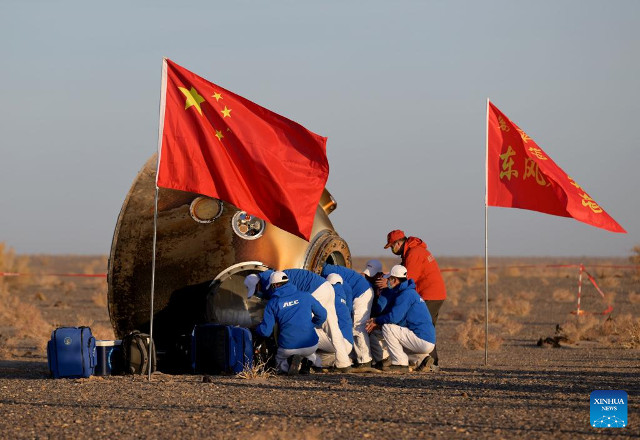
The Shenzhou 16 capsule after landing (Photo courtesy Xinhua/Li Zhipeng)

Yesterday, the three Chinese taikonauts of the Shenzhou 16 mission returned to Earth after spending 154 days on the Chinese Tiangong space station, landing at a site called Dongfeng in China’s Inner Mongolia Autonomous Region. During the capsule’s descent, some observers noticed a hole in the parachute. The speed of descent may have been faster than normal and the capsule toppled over after landing. It has already happened in the past that the capsule didn’t remain vertical and no consequences were reported for the taikonauts on board Gui Haichao, Jing Haipeng, and Zhu Yangzhu. In fact, there are no official communications regarding anomalies during the landing.

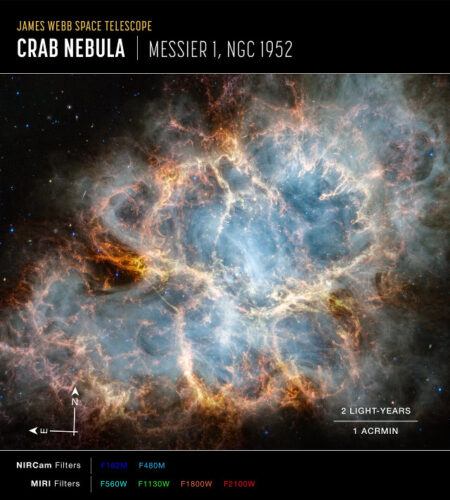
The Crab Nebula as seen by the James Webb Space Telescope

A new image captured by the James Webb Space Telescope depicts the Crab Nebula, the remnants of the supernova spotted on Earth and recorded in 1054, about 6,500 light-years away from Earth. The observation possibilities at the time were limited, to say the least, compared to today’s, so there are still questions regarding that supernova. The NIRCam and MIRI instruments allowed to obtain infrared details showing the synchrotron radiation inside it, produced by the pulsar at its center that formed from the core of the progenitor star that exploded in 1054.

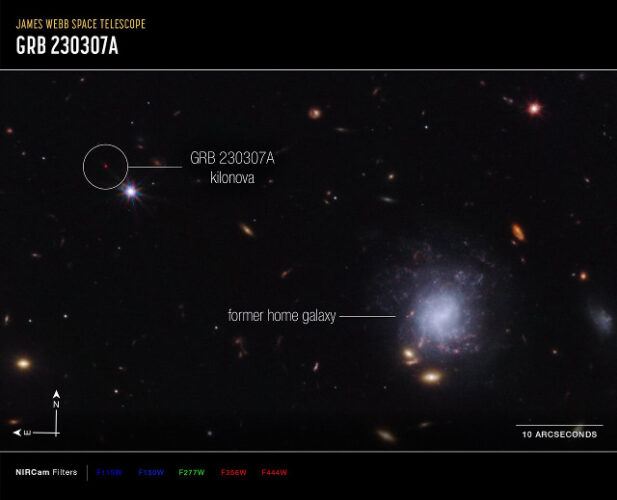
The position of the kilonova that triggered the gamma-ray burst GRB 230307A and the home galaxy from where the progenitor stars arrived.

An article published in the journal “Nature” reports the detection of heavy elements including tellurium ejected from a kilonova, the merger between two neutron stars. A team of researchers started from the gamma-ray burst cataloged as GRB 230307A to examine data collected by ground-based and space telescopes which made it possible to identify the characteristics of a kilonova at the origin of that very powerful explosion, which lasted about 200 seconds in the second brightest gamma-ray burst detected so far.

The James Webb Space Telescope made it possible to examine the environment around the kilonova with its NIRCam and NIRSpec instruments, detecting the spectroscopic traces left in the emissions from materials ejected at high speed. For the first time, tellurium, a very rare element on Earth, was detected. Webb also made it possible to ascertain that the pair of neutron stars that merged was ejected from its home galaxy hundreds of millions of years ago.

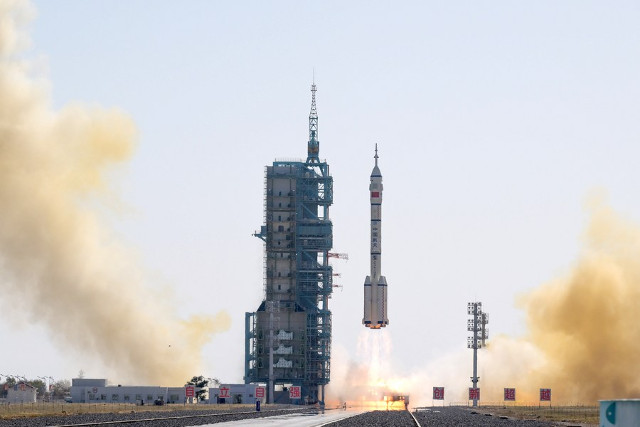
The Shenzhou 17 spacecraft blasting off (Photo courtesy Li Zhipeng)

A confirmation has arrived that three Chinese taikonauts from the Shenzhou 17 mission reached the Chinese space station Tiangong with an automated docking maneuver. They blasted off about 6.5 hours earlier atop a Long March-2F rocket from the Jiuquan Satellite Launch Center. They form the sixth crew of the Chinese space station and will remain there for about six months, the standard duration for a mission.

The three taikonauts, as the Chinese call their astronauts, of the Shenzhou 17 mission are Tang Hongbo, Tang Shengjie and Jiang Xinlin, whose names were announced only the day before the launch, as is customary for the Chinese.

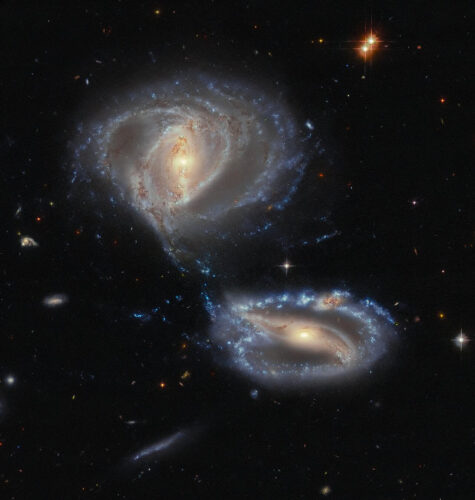
Arp-Madore 2339-661 (Image ESA/Hubble & NASA, J. Dalcanton, Dark Energy Survey/DOE/FNAL/NOIRLab/NSF/AURA Acknowledgement: L. Shatz)

An image captured by the Hubble Space Telescope depicts Arp-Madore 2339-661, an object that until not many years ago was considered a pair of interacting galaxies, cataloged as NGC 7733 (bottom right) and NGC 7734 (top left). However, observing the upper arm of NGC 7733, it’s possible to see a sort of large knot of a color different from the predominant blue which is actually a dwarf galaxy, now cataloged as NGC 7733N. The consequence is that the interaction taking place is what some call a merging group. Mergers between two galaxies are normal but sometimes there are more galaxies and in this case, there are three of them that show signs of having active galactic nuclei.