2023

A diagram illustrating the combined power of the James Webb and Hubble space telescopes in studying Cepheids present in the galaxy NGC 5584 with the NIRCam (Near-Infrared Camera) and WFC3 (Wide Field Camera 3) instruments, respectively

An article accepted for publication in “The Astrophysical Journal” reports the results of calculating the universe’s expansion rate based on the observation of Cepheids with the James Webb Space Telescope. In particular, a team of researchers led by Adam Riess used the NIRCam instrument to observe over 330 cepheids in the galaxies NGC 4258 and NGC 5584. The results are more precise than those obtained in the past with the Hubble Space Telescope but confirm the accuracy of the previous calculation of the universe’s expansion rate. This leaves open the question of the difference in results obtained with different methods.

Artist's concept of the exoplanet K2-18 b with its star in the background (Image NASA, CSA, ESA, J. Olmstead (STScI), N. Madhusudhan (Cambridge University))

An article accepted for publication in the journal “The Astrophysical Journal Letters” reports the results of a study of the exoplanet K2-18 b, including the discovery of carbon compounds such as methane in its atmosphere. A team of researchers led by Nikku Madhusudhan of the British University of Cambridge used observations conducted with the James Webb Space Telescope’s NIRISS and NIRSpec instruments to probe the atmosphere of K2-18 b. It’s an exoplanet already considered interesting due to its characteristics and its position in its planetary system’s habitable zone. Spectral analyzes also suggest the possible presence of dimethyl sulfide (DMS), a compound considered a biomarker. These are discoveries that add to the previous ones regarding an exoplanet that led to the proposal of the Hycean class.

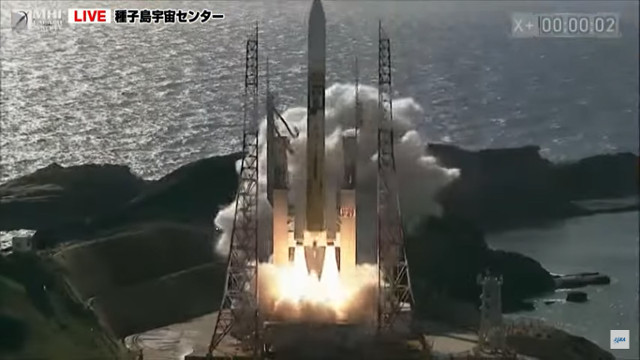
The XRISM space telescope and the SLIM Moon lander blasting off atop an H-IIA rocket (Image courtesy JAXA)

A few hours ago, the Japanese XRISM space telescope and the SLIM Moon lander were launched from the Tanegashima space center atop an H-IIA rocket. After just over 14 minutes, XRISM separated from the rocket’s last stage and after about 48 minutes, SLIM did the same. XRISM will reach low Earth orbit, where it will position at an altitude of approximately 550 kilometers. SLIM started a much longer journey.

Artist's concept of the TOI-4600 system (Image courtesy Tedi Vick)

An article published in the “Astrophysical Journal Letters” reports the discovery of two exoplanets orbiting the star TOI-4600 of which the outermost is the one with the longest year discovered so far. A team of researchers used observations conducted with NASA’s TESS space telescope to find traces of these two gas exoplanets. Other ground-based observatories were used to confirm the existence of these two exoplanets and obtain more information about them. TOI-4600 b has a year of nearly 83 Earth days, a bit shorter than Mercury’s, while TOI-4600 c has a year of nearly 483 days, the longest of all known exoplanets. This is a useful discovery to understand what other planetary systems are like because exoplanets close to their stars are much easier to discover while we still know very little about the ones far from their stars.

The Crew Dragon Endeavour spacecraft during its descent (Image NASA TV)

A few hours ago, SpaceX’s Crew Dragon Endeavour spacecraft concluded its Crew-6, or SpaceX Crew-6, mission for NASA by landing without problems. On board were astronauts Sultan Alneyadi, Woody Hoburg, and Stephen Bowen and cosmonaut Andrey Fedyaev, who had reached the International Space Station on March 3, 2023, and were part of Expedition 68/69. The four of them finished the sixth regular crewed mission of SpaceX in the Atlantic Ocean, off the coast east of Jacksonville, Florida. The Crew Dragon departed the Station about seventeen hours earlier.