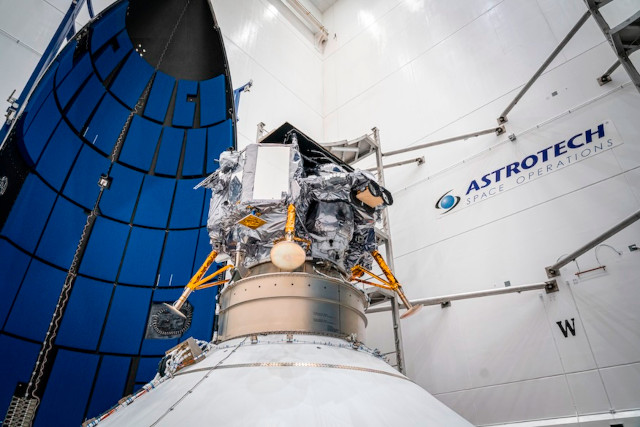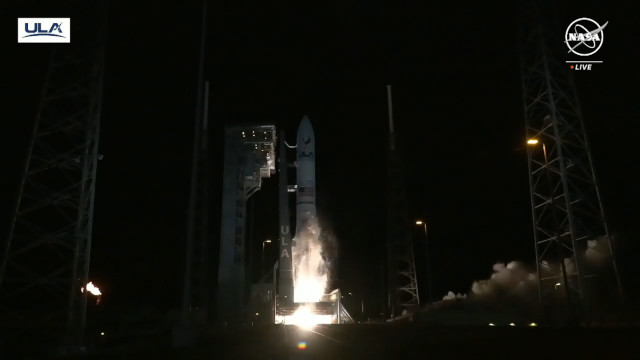
A little while ago, ULA’s Vulcan rocket launched on its maiden mission, formally designated as CERT-1. For the occasion, it was carrying Astrobotic Technology’s Peregrine Moon lander, which separated from the rocket stage called Centaur after about 50 minutes. A capsule containing ashes of various famous people was also launched into a heliocentric orbit. The Centaur continued its mission with a few burns and cut-offs of its engine until it goes out of Earth orbit, scheduled after just under 4.5 hours from the launch.
The Vulcan rocket replaces the other ULA rockets, Atlas V and Delta IV/Delta IV Heavy, bringing as its main innovation the replacement of Russian-produced engines with the American BE-4, produced by Blue Origin. The Centaur upper stage was improved to meet the needs of the National Security Space Launch (NSSL) program.
The development of the Vulcan rocket was significantly influenced by geopolitical developments that led to the need to abandon the use of Russian-produced engines. Already in 2014, the situation started becoming problematic after the tensions arising from the first Russian expansionist moves. The first sanctions against Russia already included a debate over a ban on using Russian engines for ULA’s rockets, which also has contracts to conduct launches on behalf of the US military.
ULA’s plans for the project called Vulcan began in 2015, which included reducing launch costs. There was also an announcement of a collaboration with Blue Origin, which was developing the BE-4 engine for use in its own future rockets. That’s an engine that uses methane as fuel and the Vulcan’s first stage uses two of them.
The Peregrine lander was developed as part of NASA’s Commercial Lunar Payload Services (CLPS) program through selection in 2019. Among other things, this means it carries a variety of payloads including various scientific instruments and experiments and small rovers on behalf of NASA. Some other payloads were added following commercial deals and may be symbolic such as some linked to cryptocurrencies and ashes of famous people.
The insertion of the Peregrine lander into the so-called lunar insertion trajectory was successful. To have a precise date for the Moon landing attempt, it will be necessary to wait for any course correction maneuvers that might be needed to be carried out.
For ULA (United Launch Alliance), this success is really important but it’s not enough. Plans for the recovery of the first-stage engines were communicated a few years ago and were later modified. Only when the system is successful, can ULA become a competitor for SpaceX again.