
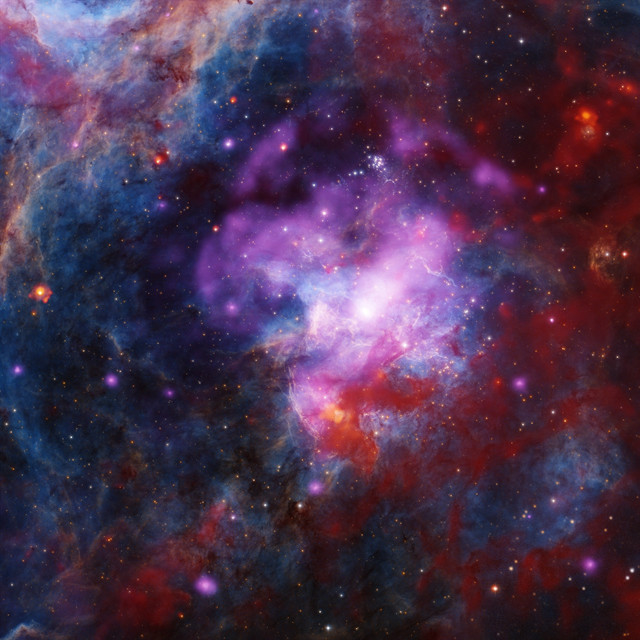
An article published in “The Astronomical Journal” reports evidence that the supernova remnant cataloged as 30 Doradus B, or simply 30 Dor B, is the result of at least two separate supernovae and not just one. A team of researchers led by Wei-An Chen of the National Taiwan University combined observations conducted with various telescopes in different electromagnetic bands to find evidence of a vast but very faint shell spanning 130 light-years that adds to the remnant visible at optical frequencies. At the same time, a wind was detected that generates a nebula of the type called pulsar wind nebula. That remnant can’t have been generated by a single supernova.
30 Doradus B is located in the so-called Tarantula Nebula, the largest star-forming region in what is known as the Local Group, the group of galaxies that includes the Milky Way. Astronomers believed it to be the remnant of a single supernova that occurred in the Large Magellanic Cloud, one of the dwarf galaxies satellite of the Milky Way, about 160,000 light-years away. This new study of this remnant indicates that there were two supernovae close in space but far apart in time.
Data was taken from a map of the Large Magellanic Cloud created using the ASKAP radio telescope. Observations of 30 Doradus B were conducted in X-ray (in purple in the image) using NASA’s Chandra Observatory, in optical frequencies (in orange and blue) using the 4-meter Blanco telescope in Chile, and in infrared using the NASA Spitzer space telescope (in red). Observations at optical frequencies have also been conducted with the Hubble Space Telescope (in black and white).
Astronomers believe the pulsar at the center of the 30 Doradus B remnant and the intense X-rays were produced by a supernova whose emissions reached Earth about 5,000 years ago. However, the big, faint halo visible on X-rays is too vast to have been generated at that time. This means that there was a previous supernova long ago that occurred in the same area.
The researchers can’t rule out the possibility that over time there were even more than two supernovae in the same area that contributed to generating the large and faint halo. In a region like the Tarantula Nebula, where there’s a remarkable formation of massive stars, it’s normal for several stars to be close and in some cases, to form multiple systems. These stars consume their hydrogen very quickly and end their lives by exploding in supernovae.
The study of multiple supernova remnants can help to better understand the life and especially the death of massive stars in areas where there are several of them in a relatively small space. The effects of supernovae are among the objects of study because they push enormous amounts of elements generated during the progenitor star’s life and death throes into interstellar space which may end up in new star systems and new planets.
