
An article in publication in “The Astrophysical Journal” reports the results of observations of early galaxies that show strange shapes, decidedly different from the ones we’re used to and compared to bananas and even breadsticks. A team of researchers led by Viraj Pandya of Columbia University used observations conducted with the James Webb Space Telescope as part of the CEERS survey from which they obtained images of galaxies dating back to a period between 600 million and 6 billion years after the Big Bang.
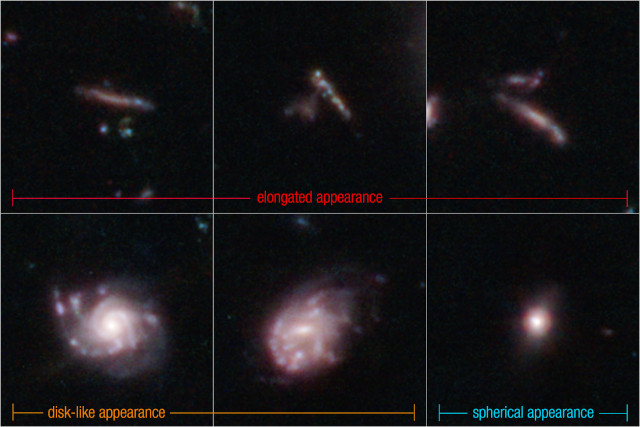
The image (NASA, ESA, CSA, STScI, Steve Finkelstein (UT Austin), Micaela Bagley (UT Austin), Rebecca Larson (UT Austin)) shows some examples of the galaxies observed during the Cosmic Evolution Early Release Science (CEERS) survey. In the top row are the strange early galaxies with elongated shapes. In the bottom row are some examples of galaxies with shapes closer to the ones typical of the nearby universe.
One of the purposes for which the James Webb Space Telescope was built was to investigate the early life stages of the universe. For this reason, the CEERS survey was among the first to exploit the NIRCam (Near Infrared Camera) instrument to capture near-infrared images that included previously unseen galaxies. In some cases, these are early galaxies with ages estimated at over 13 billion years, precisely the ones sought after by astronomers to reconstruct the first phases of the history of the universe.
Many early galaxies were already discovered using telescopes such as Hubble. They already showed the presence of elongated galaxies but the new images show how common shapes were that were truly different from the spiral or elliptical ones we normally see.
The comparisons for the new strange galaxies discovered thanks to the CEERS survey are diverse and range from bananas to breadsticks for the most elongated galaxies but there are also the ones compared to surfboards. Those shapes appear common in the new images, a situation completely different from that of the close, and therefore recent universe.
The new images captured with the James Webb Space Telescope show many new details and confirm the strange shapes discovered with Hubble, finding that there was even more variety than astronomers thought. The Milky Way may also have had an elongated shape early in its life and then transformed into the current spiral galaxy.
The first question concerns the reasons why early galaxies so often had shapes that are very different from their current ones. For now, there are only hypotheses such as the presence of long filaments of dark matter that attracted the gas and stars across them. These filaments must have become diffuse over time, allowing galaxies to significantly change their shape. From this point of view, this type of research is also useful for testing the various models regarding dark matter and the alternative ones that don’t predict its existence and offer different explanations for the observed gravitational effects.
This research into the evolution of galaxies is only just beginning. Further observations with the James Webb Space Telescope will be needed to expand the sample of early galaxies and an examination of the information obtained to improve current models of galaxy evolution. It’s the only way to understand the reasons behind the shapes of early galaxies and the dramatic changes that happen over time.
