
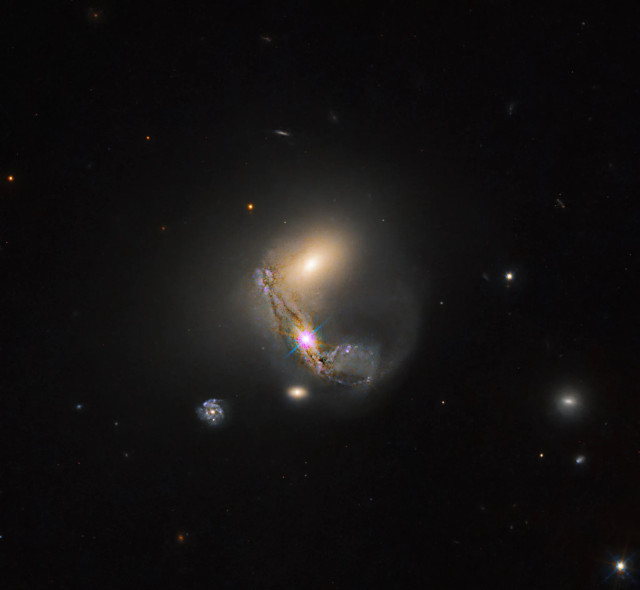
An image captured by the Hubble Space Telescope shows LEDA 60847, a group of interacting galaxies. The largest galaxy has an active galactic nucleus (AGN) with a supermassive black hole surrounded by materials that are heated to the point of generating the electromagnetic emissions behind its luminosity. This galaxy is interacting with its neighbors and in a very long time, they will form a single larger galaxy.
Nearly 190 million light-years away from Earth, LEDA 60847 is a common case in the sense that a lot of galaxies are interacting in some way and are often in some stage of the merging process. Massive galaxies are normally the result of mergers and if one galaxy is much more massive than the other, their merger can mean that the larger one swallows the smaller one. This also happened to the Milky Way, where there are still traces of those ancient processes.
In the case of LEDA 60847, the Hubble Space Telescope used a combination of filters that span all of its detection capabilities, ranging from ultraviolet to near-infrared with visible frequencies in between. The James Webb Space Telescope is extraordinary in infrared astronomy, where it can offer performances impossible for other instruments but the good old Hubble was built to observe in different electromagnetic bands and that’s one of the reasons why it’s still extremely useful.
Ultraviolet emissions reveal the presence of massive stars and stellar nurseries in which sometimes chaotic and energetic processes are taking place. Emissions at visible frequencies reveal the presence of stars with masses closer to the Sun’s. Infrared reveals the presence of dwarf stars and are among the few frequencies that pass through dust allowing us to see inside dense clouds.
In the case of an active galactic nucleus such as the one in the largest LEDA 60847 galaxy, an instrument capable of making observations in different electromagnetic bands such as the Hubble Space Telescope can provide broader detections of the emissions. That’s very useful for studying the influence of the supermassive black hole on its host galaxy, for example, to understand the influence of its activity on star formation.
It will take who knows how many more millions of years before LEDA 60847 reaches a new equilibrium after the end of the merger process. Astronomers continue to observe this and many other groups of galaxies in various merger stages to understand the processes taking place and their consequences.
