January 2024

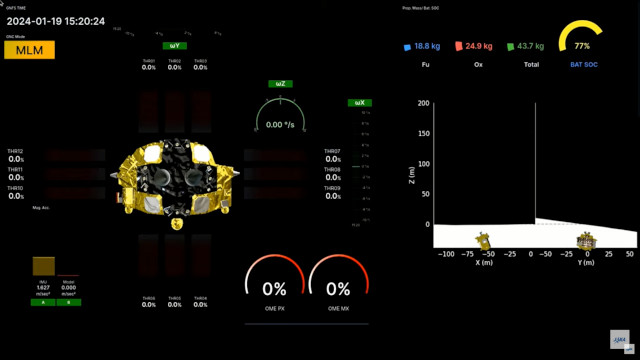
Image from the SLIM lander Moon landing simulation

It was the night between Friday and Saturday in Japan when the Japanese space agency JAXA’s SLIM lander attempted to land on the Moon but things got complicated. Only after a couple of hours, a press conference was held in which it was announced that the Moon landing was successful but there were some problems that could shorten the mission if SLIM fails to recharge its batteries. Meanwhile, Japan has become the fifth nation to put a robotic vehicle on the Moon.

The Crew Dragon Freedom spacecraft blasting off to begin the Ax-3 mission (Image courtesy Axiom Space)

A few hours ago, SpaceX’s Crew Dragon Freedom spacecraft was launched atop a Falcon 9 rocket from the Kennedy Space Center on the Axiom Mission 3, or simply Ax-3, mission. After about twelve minutes, it successfully separated from the rocket’s last stage. It will spend about 14 days in orbit, almost all of which will be docked at the International Space Station. It also serves commercial purposes in a collaboration between SpaceX, Axiom Space, and various companies and national space agencies to access the Station for the purpose of conducting tasks useful for the development of new technologies and for scientific research.

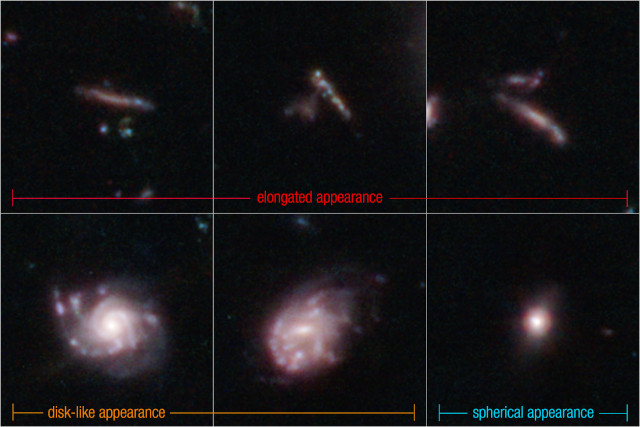
Some examples of the galaxies observed during the Cosmic Evolution Early Release Science (CEERS) survey

An article in publication in “The Astrophysical Journal” reports the results of observations of early galaxies that show strange shapes, decidedly different from the ones we’re used to and compared to bananas and even breadsticks. A team of researchers led by Viraj Pandya of Columbia University used observations conducted with the James Webb Space Telescope as part of the CEERS survey from which they obtained images of galaxies dating back to a period between 600 million and 6 billion years after the Big Bang.

Illustration of the HD 63433 star system

An article published in “The Astronomical Journal” reports confirmation of the existence of the exoplanet HD 63433d, a rocky planet with a size close to the Earth’s that orbits a star very similar to the Sun in a system that was already known. A team of researchers led by Melinda Soares-Furtado of the University of Wisconsin-Madison and Benjamin Capistrant, now a student at the University of Florida, used data collected by NASA’s TESS space telescope to identify HD 63433d within the THYME (TESS Hunt for Young and Maturing Exoplanets) survey. Its close proximity to its star probably makes it a so-called lava planet since on the dayside, the temperature on its surface is estimated at over 1,500° Kelvin.

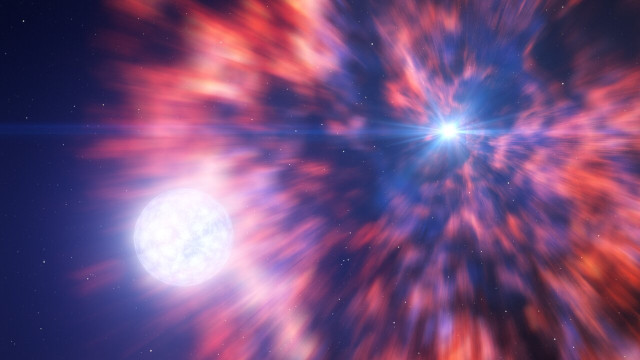
Artist's concept of the aftermath of a supernova in a binary system (Image ESO/L. Calçada)

Two articles, one published in the journal “Nature” and one in “The Astrophysical Journal Letters”, report different aspects of a study of the supernova remnant cataloged as SN 2022jli which include evidence of the presence of a compact object that could be a neutron star or a black hole that formed after the supernova. Two teams of researchers used various instruments including the Very Large Telescope (VLT) and the New Technology Telescope (NTT), both ESO’s, to study the consequences of this supernova and find the direct link to the formation of a compact object.