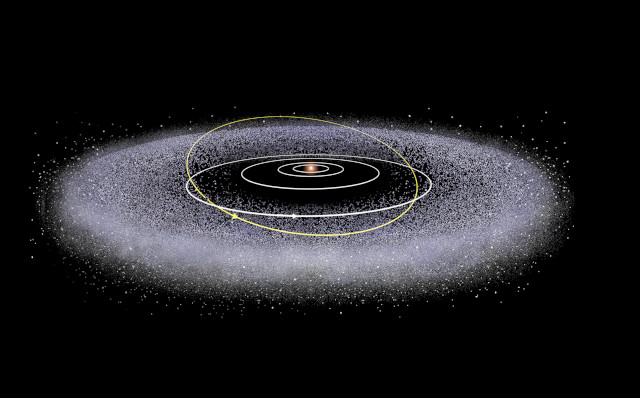
An article published in “The Astrophysical Journal Letters” reports a study of the presence of dust in the Kuiper Belt which suggests that it may be much more extended than previously thought or that there’s a second Belt outside the known one. A team of researchers used detections conducted with NASA’s New Horizons space probe’s Venetia Burney Student Dust Counter (VBSDC, or simply SDC) instrument to support these possibilities. That’s because current models indicate that dust density should decrease in the area where New Horizons is traveling, where detections are higher than expected.
More than five years after its flyby of the asteroid that was later officially named Arrokoth, the New Horizons space probe continues to move away from the Sun. It still has fuel that could be used if another interesting object is discovered in a reachable location.
In recent years, New Horizons has been continuing to conduct surveys, for example with its VBSDC instrument, built by students at the University of Colorado to measure the amount of dust encountered by the space probe. The VBSDC was used throughout the mission to obtain information on dust produced by comets and collisions of objects that may be too small to be seen by telescopes.
Now that New Horizons is in the Kuiper Belt, dust detection is even more interesting because it’s the first made beyond Neptune and Pluto. According to the models, dust should decrease towards the edges of the Belt, as there should be fewer objects and fewer collisions generating that dust. Instead, the detections indicate that there’s a greater quantity than expected at a distance from the Sun between 45 and 55 times greater than the Earth’s.
Over the past few years, other objects have been discovered in the Kuiper Belt whose distance from the Sun is greater than what were considered the Belt’s outer boundaries. Previously, astronomers thought the Belt ended about 50 times farther from the Sun than the Earth, but observations and dust detections suggest it may extend much further, perhaps as much as 80 times farther from the Sun than the Earth.
The researchers tried to consider other possible explanations for the amount of dust detected. The second most likely possibility is that there’s a second Kuiper Belt separate from the first and more distant. New Horizons may be in the second Belt but it’s difficult to find a real separation that justifies the idea of a double Belt.
A less likely possibility is that dust generated in the inner Kuiper Belt is pushed outward, by radiation pressure and other processes. The possibility that these are short-lived icy particles that cannot reach the inner solar system and were not included in the models also seems unlikely.
The researchers also mentioned interstellar dust. Astronomers expect the New Horizons space probe to reach an area where the environment is dominated by interstellar particles towards the end of its mission, expected after 2040. At that point, its distance from the Sun will be more than 100 times greater than the Earth’s, another frontier for a space probe.
For now, the New Horizons space probe continues to conduct surveys of the dust it encounters, and the data continues to be analyzed. At the same time, various telescopes help to find other objects in the Kuiper Belt. All this could confirm that our knowledge of the Belt needs to be radically revised.