
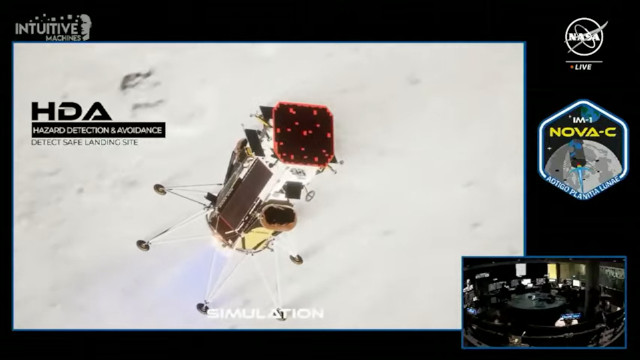
It was the afternoon in the USA when Intuitive Machines’ Nova-C Odysseus lander attempted its Moon landing in the Malapert A crater. It was an autonomous maneuver that constituted the crucial step of the IM-1 mission. It took about 10 minutes to receive the first faint signals from Odysseus but they were invaluable in confirming the Moon landing. At Intuitive Machines’ mission control center, work began to have regular communications that allow them to understand Odysseus’ exact status and receive the data collected, including images.
Launched on February 15, the Odysseus lander made a journey to the Moon that was relatively short but certainly not boring. This is the first space trip for a Nova-C lander and the first ever for a vehicle with a liquid methane and liquid oxygen engine, and any unusual detections are examined with extreme care.
The launch of the Odysseus lander was postponed following an anomaly detected in the temperature of the methane used as fuel. During the journey, some minor problems with onboard systems led to delays in its engine tests, which were ultimately conducted successfully. Once the Moon orbit was reached, some problems were detected with the laser system that helps navigation and it was decided to make an extra orbit before starting the Moon landing maneuvers to switch to using a different instrument.
During the journey to the Moon, the operation of the onboard instruments that are not specifically designed for the Moon’s surface, some of which are transported on behalf of NASA, was also tested, and the outcome was a success as well. As a result, data collected by some instruments was already transmitted to Earth.
The Nova-C lander’s Moon landing system includes instruments that can detect potentially dangerous objects on the ground such as boulders and move laterally to reach the ground at a safe place. At the end of the maneuvers, there were about ten minutes of tension before a weak signal from Odysseus was detected.
After the relief and the various messages of congratulations for the success of the first Moon landing by a private company, albeit in collaboration with NASA, a new phase of work has begun for Intuitive Machines. After a few hours, confirmation arrived that the Odysseus lander landed on its feet but communications are weak, so it’s possible that there’s some problem with the orientation of its antennas.
The Odysseus lander situation is very dynamic and at this point, it’s hoped that it will quickly change for the better with stable communications. All the companies and entities involved in the IM-1 mission are waiting for images and other data, also from the EagleCam nanosatellite ejected shortly before the Moon landing to film it from outside. Nova-C landers are not made to withstand the lunar night, so there are about 14 Earth days to do all the work.
Edit. The analysis of the data received indicates that Odysseus tipped onto its side. It receives light to its solar panels but its useful life may be limited. The EagleCam wasn’t ejected but they will try to use it in the next few days.
