February 2024

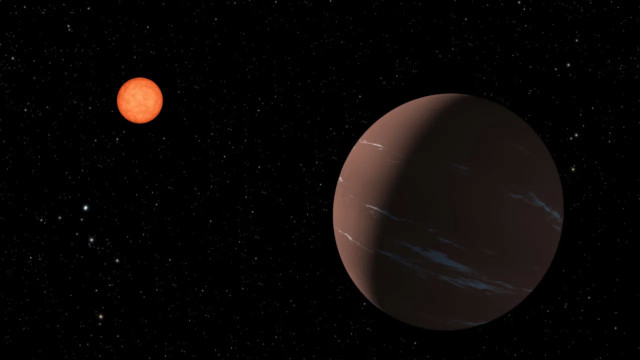
Artist's concept of the exoplanet TOI-715b with its star in the background (Image NASA / JPL-Caltech)

An article published in the journal “Monthly Notices of the Royal Astronomical Society” reports the identification of the exoplanet TOI-715 b in an orbit around its star in a position that meets the most conservative definition of a habitable zone. A team of researchers used observations conducted with NASA’s TESS space telescope confirmed by other instruments to identify what appears to be a super-Earth with a radius about 1.5 times the Earth’s. A second exoplanet candidate was discovered that would have a size very similar to the Earth’s a little further away from its star but follow-up observations are needed to verify that it’s not a false positive.

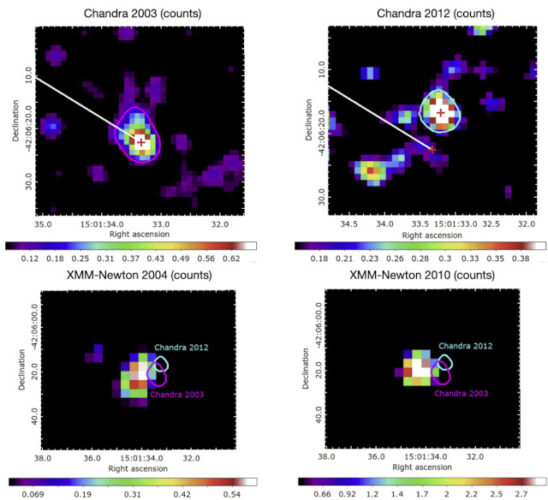
Four X-ray observations of the supernova remnants SN 1006

An article published in the journal “Astronomy & Astrophysics” reports a study of the supernova remnant cataloged as SN 1006 which led to the identification of an ejecta fragment of the progenitor star. A team of researchers led by Roberta Giuffrida of the University of Palermo and the Italian National Institute of Astrophysics used observations conducted with various telescopes exploiting X-ray emissions and compared them with theoretical models. The conclusion is that this iron-rich fragment is moving at a very high speed within the debris cloud generated by the supernova. This discovery is useful in the study of supernovae like this one, generated by explosions of white dwarfs.

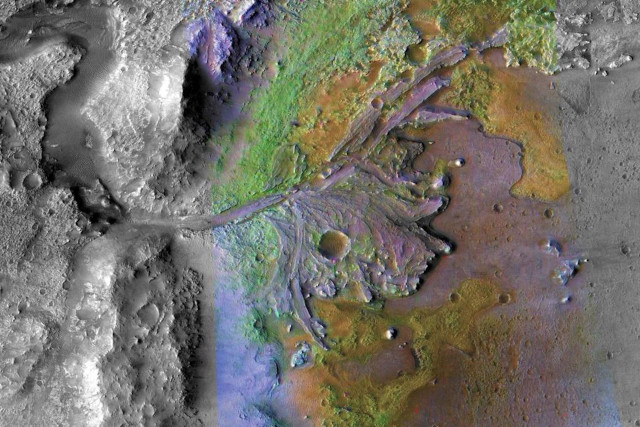
Photo of the area where a river delta entered the lake that existed in Jezero Crater (Image NASA/JPL-Caltech/ASU)

An article published in the journal “Science Advances” reports new evidence that Jezero Crater on Mars was a lake when the red planet was young and much more Earth-like. A team of researchers coordinated by UCLA (University of California at Los Angeles) and the University of Oslo used data collected by the RIMFAX radar (Radar Imager for Mars’ Subsurface Experiment) mounted on NASA’s Mars Rover Perseverance, exploiting its ability to carry out detections underground to a depth of 20 meters.

Data collected between May 20 and December 8, 2022, in a contact area between the crater floor and the delta of an ancient river, made it possible to map that area and reconstruct the sequence of erosions and sediment deposits. Conditions were favorable for the development of life forms and there may still be traces of them in the samples collected by Perseverance.

The Cygnus S.S. Patricia “Patty” Hilliard Robertson cargo spacecraft captured by the Canadarm2 robotic arm (Image NASA TV)

Northrop Grumman’s Cygnus spacecraft, launched last Tuesday, January 30, has just reached the International Space Station and was captured by the Canadarm2 robotic arm. Astronaut Loral O’Hara, assisted by his colleague Jasmin Moghbeli, will soon begin the slow maneuver to move the Cygnus until it docks with the Station’s Unity module after about two hours.