
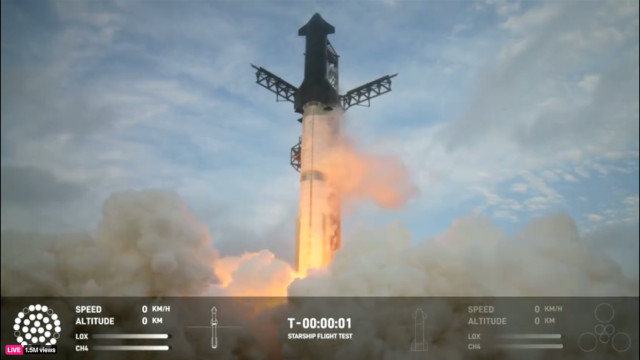
SpaceX conducted a new flight test of its Super Heavy rocket and Starship prototypes, launched from its base in Boca Chica, Texas. This is the third test involving the entire system of Elon Musk’s company which is supposed to revolutionize space travel with an unprecedented transport capacity and being totally reusable. In this case, however, they are prototypes with the Super Heavy identified as Booster 10 and the Starship identified as Starship 28 or Ship28 or simply S28. After the second test conducted on November 18, 2023, many changes were made to the Super Heavy and Starship systems. Despite the upgrades, they don’t have the safety requirements required to conduct controlled landings, so the plans continue to have the test ending with both vehicles splashing down.
The second test showed the progress made in the development of SpaceX’s new launch system. Despite this, both Booster and Starship ended their journey with an explosion. These are prototypes, and for this reason, the reactions from SpaceX were still positive, following Elon Musk’s philosophy of obtaining results through explosions and, therefore through trial and error.
The trajectory of the Starship in today’s test is different from the previous tests, with a planned splashdown in the Indian Ocean instead of the Pacific. The aim was still to test the onboard systems of Super Heavy and Starship and their maneuverability.
The Super Heavy Booster 10 accomplished its mission with success in the separation and what in the live broadcast looked like a splash down, in its case, in the Gulf of Mexico as it was supposed to happen in the previous tests in case of success. Some motors ignited for the braking during maneuvers but that happened only for 2 of the 13 required for the correct maneuver. As a result, Booster 10 experienced a hard splashdown and was destroyed.
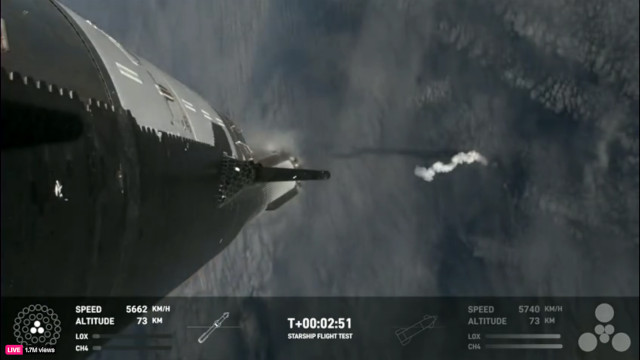
Starship 28 reached over 170 kilometers in altitude, higher than that achieved in the second test. The opening and closing of the payload door that in a normal mission will allow the separation of the payloads was successful and that’s another step forward. During the descent of Starship 28, SpaceX received telemetry data up to an altitude of approximately 65 kilometers, a complex phase because, for the first time, a prototype faced the strong stresses, including thermal stress, typical of the passage through the atmosphere. Starship 28 never made it over the Indian Ocean and eventually came to the inevitable conclusion that it was destroyed.
In the end, however, there was satisfaction during the SpaceX live broadcast for the progress achieved. Satellites from the Starlink network were also used to maintain connections with Super Heavy 10 and Starship 28 for as long as possible and certainly, a lot of telemetry data was collected which will help to understand where work still needs to be done to achieve success of this launch system.

