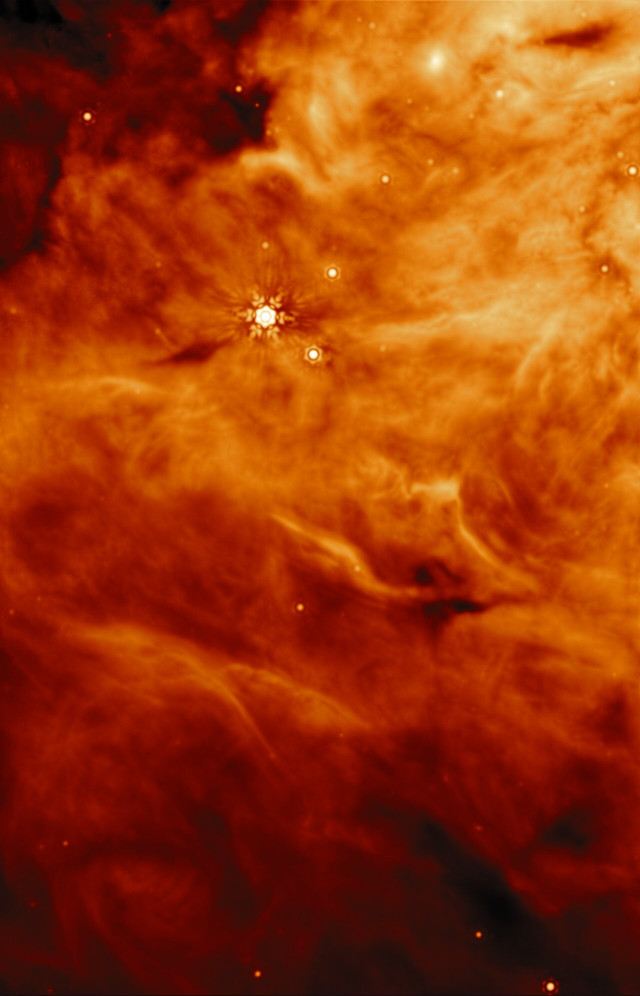
An article published in the journal “Astronomy & Astrophysics” reports the discovery of various complex organic molecules such as ethanol among the icy materials surrounding two protostars. A team of researchers used the James Webb Space Telescope’s Mid-Infrared Instrument (MIRI) to identify icy organic compounds around the low-mass protostar NGC 1333 IRAS 2A, or simply IRAS 2A, and the high-mass protostar IRAS 23385+ 6053, or simply IRAS 23385. Various molecules constitute building blocks for Earth-like life forms that could be like “seeds” on planets still in the process of formation.
Complex organic molecules have already been discovered in molecular clouds and planetary systems still forming. However, so far, it wasn’t possible to establish if there are cases where they exist in space in the form of ice. This would be important to understand if complex chemical reactions can occur in a solid phase on the surface of cold dust grains. This new study suggests that this is possible and that these molecules then pass into a gaseous state after their sublimation.
Over 30 protostars are under study with the James Webb Space Telescope as part of the JWST Observations of Young protoStars (JOYS+) program. In particular, the MIRI and Medium Resolution Spectrograph (MRS) instruments were used with the aim of identifying the chemical signatures left in the electromagnetic emissions coming from those protostars by the molecules present in the circumstellar disks that surround them. The article published in “Astronomy & Astrophysics” focuses in particular on two of those protostars: IRAS 2A and IRAS 23385.
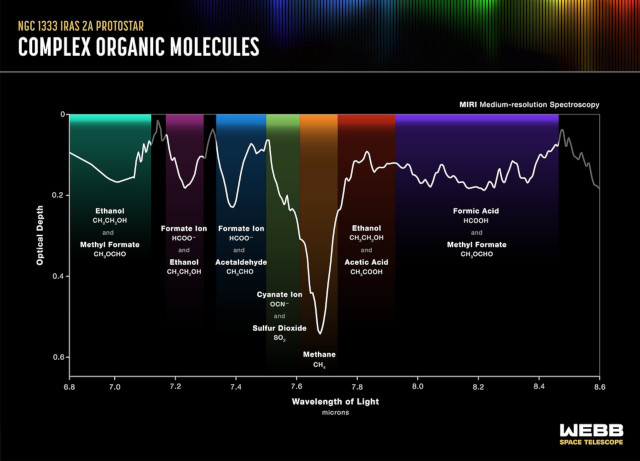
The result is that many organic molecules were found in the icy materials surrounding the protostars IRAS 2A and IRAS 23385, including some complex ones such as ethanol, the common alcohol found in drinks, and one that could be acetic acid. Simpler molecules such as formic acid, methane, and formaldehyde were also identified. There’s also sulfur dioxide, a molecule that may have been important in driving metabolic reactions on early Earth.
IRAS 2A is a low-mass protostar that may be similar to the early solar system. If this proves true, the circumstellar disk surrounding it will turn out to be a protoplanetary disk in which planets will form. Those molecules present in the disk might become like seeds on the new planets thanks to the passage of asteroids and especially comets. If suitable conditions appear on at least one planet, life forms similar to those on Earth could emerge.
The possibility that organic molecules, including complex ones, are present around protostars or very young stars is important. The possibility that chemical reactions occur even at very low temperatures increases the probability that key ingredients for the birth of life forms will be formed. The chances of these molecules becoming part of asteroids and comets are considered higher if they are in their solid phase.
The researchers also conducted a comparison between the molecules present in the two circumstellar disks of IRAS 2A and IRAS 23385. They also included in the analysis the ice of comet 67P/Churyumov-Gerasimenko, the one visited by ESA’s Rosetta space probe during its extraordinary mission, concluded on September 30, 2016.
This study is focused on two protostars and more information may come from studies conducted taking advantage of the JOYS+ program. This will allow to conduct other comparisons regarding the organic molecules present in circumstellar disks and have a clearer picture of the processes that lead to their formation and diffusion on the planets, with the potential connected to the emergence of life forms.
The bottom image (NASA, ESA, CSA, L. Hustak (STScI)) shows results of spectroscopic analyzes of the protostar IRAS 2A and its circumstellar disk. It bears the chemical signatures of acetaldehyde, ethanol, methylformate, and likely acetic acid, in their solid phase.