
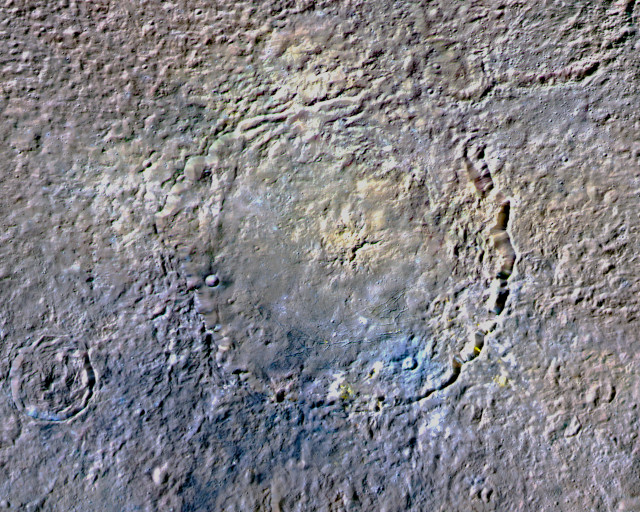
An article published in the journal “Communications Earth & Environment” reports the discovery of ammonium-rich areas in the famous bright spots on the dwarf planet Ceres. A team of researchers composed of Maria Cristina De Sanctis, Filippo Giacomo Carrozzo, Mauro Ciarniello, Simone De Angelis, Marco Ferrari, Alessandro Frigeri, and Andrea Raponi from the Italian National Institute of Astrophysics’ Institute of Space Astrophysics and Planetology in Rome and Eleonora Ammanito of the Italian Space Agency examined data collected by NASA’s Dawn space probe focusing on Dantu crater to identify these compounds, which include a new ammonium salt.
These results are not just a scientific curiosity because they confirm more than ever that complex chemical reactions occurred on this dwarf planet at least in the past, including some at a prebiotic level. They also suggest the possible existence of complex hydrothermal systems that would allow the circulation of saline fluids from Ceres’ interior to its surface. It would be a brine since the water must be, or must have been in the past, highly salty.
The mission of the Dawn space probe ended on November 1, 2018, but the wealth of data obtained represents a treasure that continues to be the subject of studies. The now famous faculae, the bright spots on the surface of the dwarf planet Ceres, revealed the presence of salts that indicated that at least in the past water flowed in a liquid state beneath the surface.
Faculae are commonly called bright spots but researchers actually detected differences in colors that led to dividing them into white faculae and yellow faculae. The Dawn space probe’s VIR spectrometer was used by various teams of researchers to study the various faculae, finding different types of compounds that determine the different colors. This study is focused on Dantu crater, one of the largest and deepest on the dwarf planet Ceres, where both white and yellow faculae are present. Analysis of data collected by VIR revealed large amounts of ammonium compounds in the yellow faculae.
In various areas of Dantu crater’s yellow faculae, the chemical signatures left in electromagnetic emissions from ammoniated phyllosilicates, which are clays that contain ammonium, were detected by the VIR instrument. However, recognizing a specific compound requires comparing VIR data with data acquired in the laboratory, even carrying out new detections for this study. The result was that ammonium bicarbonate is the compound that generates the spectroscopic signature most similar to the one detected by VIR in yellow faculae. It’s added to other salts discovered in recent years in other faculae, especially in Occator crater.
In recent years, theories were proposed regarding the presence of cryovolcanoes on the dwarf planet Ceres, which erupt liquids and volatile compounds that evaporate and disperse, leaving salts mixed with other compounds such as organic ones on the surface. Now the discoveries made in Dantu crater suggest that there may be complex hydrothermal systems that drive the circulation of saline fluids within Ceres towards its surface. In short, there are confirmations of the geological complexity of this dwarf planet.
Over the years, various groups of researchers tried to understand if there may still be liquid water on Ceres. Ammonia is a powerful antifreeze and the strong presence of salts can generate a brine that might remain liquid at very low temperatures. The fact that ammonia is involved in many prebiotic chemical reactions is another element of interest to astrobiologists.
Maria Cristina De Sanctis stressed the fact that the discovery of the new salt and the new mix of ammonium compounds enriches the catalog of molecules detected on Ceres that are interesting to astrobiologists. It offers further confirmation of the chemical complexity existing on the dwarf planet and its importance as a target in solar system exploration.
