March 2024

SpaceX's Dragon 2 cargo spacecraft blasting off atop a Falcon 9 rocket in its CRS-30 mission (Image NASA TV)

A few hours ago, the SpaceX Dragon 2 spacecraft blasted off atop a Falcon 9 rocket from Cape Canaveral in its CRS-30 (Cargo Resupply Service 30) mission, also referred to as SPX-30. After almost exactly 12 minutes it separated successfully from the rocket’s last stage and went en route. This is the 30th mission for the Dragon/Dragon 2 spacecraft to resupply the International Space Station with various cargoes and then return to Earth, again with various cargoes.


A region of a molecular cloud (Image ESA/Webb, NASA, CSA, W. Rocha et al. (Leiden University))

An article published in the journal “Astronomy & Astrophysics” reports the discovery of various complex organic molecules such as ethanol among the icy materials surrounding two protostars. A team of researchers used the James Webb Space Telescope’s Mid-Infrared Instrument (MIRI) to identify icy organic compounds around the low-mass protostar NGC 1333 IRAS 2A, or simply IRAS 2A, and the high-mass protostar IRAS 23385+ 6053, or simply IRAS 23385. Various molecules constitute building blocks for Earth-like life forms that could be like “seeds” on planets still in the process of formation.

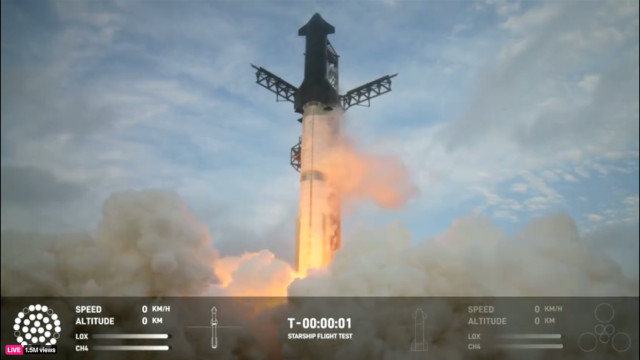
Super Heavy 10 and Starship 28 blasting off (Image courtesy SpaceX)

SpaceX conducted a new flight test of its Super Heavy rocket and Starship prototypes, launched from its base in Boca Chica, Texas. This is the third test involving the entire system of Elon Musk’s company which is supposed to revolutionize space travel with an unprecedented transport capacity and being totally reusable. In this case, however, they are prototypes with the Super Heavy identified as Booster 10 and the Starship identified as Starship 28 or Ship28 or simply S28. After the second test conducted on November 18, 2023, many changes were made to the Super Heavy and Starship systems. Despite the upgrades, they don’t have the safety requirements required to conduct controlled landings, so the plans continue to have the test ending with both vehicles splashing down.

The Crew Dragon Endurance spacecraft after its splashdown that end its Crew-7 mission (Image NASA TV)

A little while ago, SpaceX’s Crew Dragon Endurance spacecraft concluded its Crew-7, or SpaceX Crew-7, mission for NASA by landing without problems. On board were astronauts Jasmin Moghbeli, Andreas Mogensen, and Satoshi Furukawa and cosmonaut Konstantin Borisov, who had reached the International Space Station on August 27, 2023, and were part of Expedition 69/70. The four of them finished the seventh regular crewed mission of SpaceX in the Atlantic Ocean, off the coast of Pensacola, Florida. The Crew Dragon departed the Station a bit more than 18 hours earlier.

Some of the systems observed with the VLT and represented here not in scale to appear similar in size

Three articles published in the journal “Astronomy & Astrophysics” report different aspects of a large study of 86 protoplanetary disks located in three different regions of the Milky Way. Teams of researchers with several shared members used the SPHERE instrument mounted on ESO’s Very Large Telescope (VLT) in Chile as part of the GTO and DESTINYS observation programs. The findings offer a treasure trove of information about planetary formation in the cosmic neighborhood that could lead to advances in current models and aid follow-up studies.