
An article published in “The Astrophysical Journal” reports a study of supermassive black holes that emit jets of energy that are aimed in different directions over time. A team of researchers led by Francesco Ubertosi of the University of Bologna, Italy, combined observations conducted with NASA’s Chandra X-ray Observatory and the VLBA radio telescope to examine 16 galaxies finding that about a third of their supermassive black holes emit jets that changed direction significantly within the last 10 million years. For this type of emission, they were compared to the Death Star.
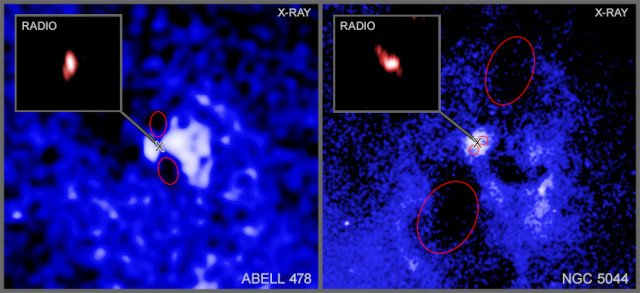
The image (X-ray: NASA/CXC/Univ. of Bologna/F. Ubertosi; Insets Radio: NSF/NRAO/VLBA; Wide field Image: Optical/IR: Univ. of Hawaii/Pan-STARRS; Image Processing: NASA/CXC/SAO/N. Wolk) shows the galaxies Abell 478 and NGC 5044 seen in X-rays by the Chandra Observatory with data detected at radio waves by the VLBA (Very Large Baseline Array) radio telescope zoomed in the insets.
Jets emitted from the poles of supermassive black holes are common and have been observed in multiple cases. However, the orientation of these jets isn’t always the same for all, and observations of galaxies and their supermassive black holes showed misalignments between those jets and the cavities visible in X-rays, bubbles formed in the hot gas present in galaxy groups and clusters which are dug by the jets. This study attempted to investigate these misalignments.
Radio images observed by the VLBA radio telescope show where the jets emitted by the supermassive black holes object of this study are currently pointing. Comparison with X-ray data obtained from the Chandra Observatory indicates that in about a third of the 16 galaxies studied, those jets changed direction. In some cases, the direction has changed by almost 90 degrees on time scales ranging from a million to a few tens of millions of years. These are galaxies that are around 10 billion years old, so the change is considered quick in astronomical terms.
The researchers examined the data to try to understand whether there might be other reasons for the misalignment between jets and cavities that led to explanations other than a reorientation of the jets. They can’t completely rule out gas motions that might have perturbed the cavities pushing them away from their original trajectory but the characteristics detected indicate that a perturbed environment couldn’t have had an important role in producing strong misalignments. Instead, they believe that the supermassive black holes’ spin and geometry of the accretion flow can influence the direction of the jets.
In essence, in the researchers’ reconstruction, some supermassive black holes emit jets of very high energy particles which, at a certain point, change direction, sometimes significantly. It’s not a system that charges and discharges but Francesco Ubertosi, who has been studying the characteristics of these jets and the cavities generated for years, compared this phenomenon to the Death Star from Star Wars.
Among the objects of study linked to supermassive black holes is the influence that these extreme objects have on the surrounding environment, sometimes on the entire galaxy that hosts them. The jets they emit and the cavities they generate could have an important influence on star formation activity. The jets add energy to the hot gas but stars form from cold gas, so the jets inhibit star formation. A change in the direction of the jets can have the same effect on different areas of a galaxy. In short, instead of destroying planets, Death Star supermassive black holes prevent the formation of stars and therefore planets.
