May 2024

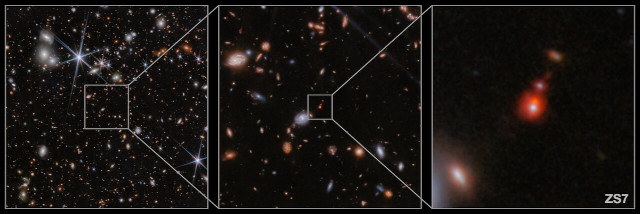
The position of the ZS7 system in past observations

An article published in the journal “Monthly Notices of the Royal Astronomical Society” reports evidence of the ongoing merger of two supermassive black holes in a pair of galaxies cataloged as ZS7 in the early universe. A team of researchers used observations conducted with the James Webb Space Telescope to obtain images of this event which we see as it was taking place when the universe was about 740 million years old and was therefore very young in astronomical terms. This is the most distant pair of merging black holes discovered so far and could offer insights valuable to understand how these extreme objects grew so quickly.

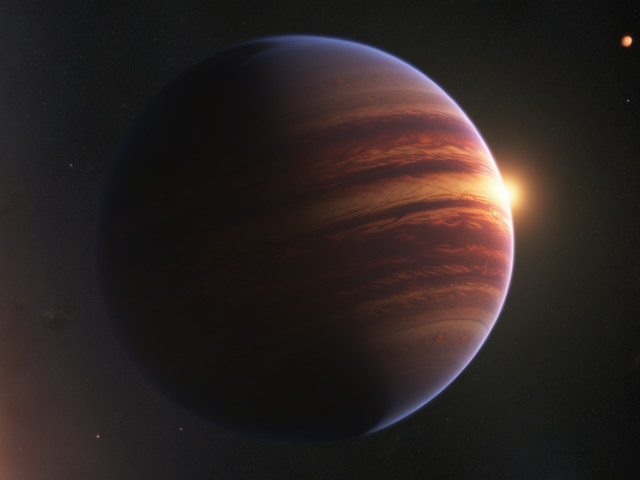
Artistic representation of the exoplanet WASP-193 b

An article published in the journal “Nature Astronomy” reports the identification of the exoplanet WASP-193 b, a gas giant whose diameter is approximately 1.5 times Jupiter’s but with a mass that is only one-seventh of Jupiter’s. A team of researchers led by Khalid Barkaoui of the University of Liège, Belgium, used the WASP-South telescope of the Wide Angle Search for Planets (WASP) collaboration to locate WASP-193 b and then study its characteristics with other instruments. The combination of this exoplanet’s mass and density is really difficult to explain since no theory of planetary formation leads to a planet like this.

A diagram of a secondary eclipse and a graph of the resulting change in brightness over time in the 55 Cancri system based on detections by the James Webb Space Telescope's MIRI instrument

An article published in the journal “Nature” reports the results of a study of the exoplanet 55 Cancri e, formally called Janssen, which confirms the presence of an atmosphere that is considered secondary, which means that it derives from emissions coming from the planet itself. A team of researchers led by NASA’s Jet Propulsion Laboratory (JPL) used observations conducted with the James Webb Space Telescope to detect traces of an atmosphere that may be rich in carbon monoxide or carbon dioxide.

The quasar J0148+0600

An article published in “The Astrophysical Journal” reports the results of observations of primordial quasars that indicate that supermassive black holes form from “seeds” that are very massive and grow quickly. A team of researchers used observations conducted with the James Webb Space Telescope as part of the EIGER project to detect the faint light of the stars surrounding three of those quasars. This feat offers the possibility of obtaining much more information that allows to estimate the mass of galaxies and central supermassive black holes.

The estimates obtained for the three galaxies at the center of this study indicate that the primordial supermassive black holes were much more massive than today’s supermassive black holes compared to their host galaxies. According to the researchers’ reconstruction, primordial quasars powered by black holes engulfed materials at enormous speeds as they went from initial seeds to supermassive black holes.

Magnetite particles cut from an asteroid Ryugu's sample

An article published in the journal “Nature Communications” reports the results of tests conducted on samples from the asteroid Ryugu brought back to Earth by the Japanese space agency JAXA’s Hayabusa 2 space probe. A team of researchers led by Professor Yuki Kimura of Hokkaido University found traces of the effects probably caused by the bombardment of micrometeorites.

In particular, the technique called electron holography made it possible to discover that the tiny grains called framboids, composed of magnetite, completely lost the magnetic properties they normally have. According to Professor Kimura, this type of study can also be useful for estimating the degradation caused by interplanetary dust on spacecraft.